Mobile Robot / AMR Vision Host Solution
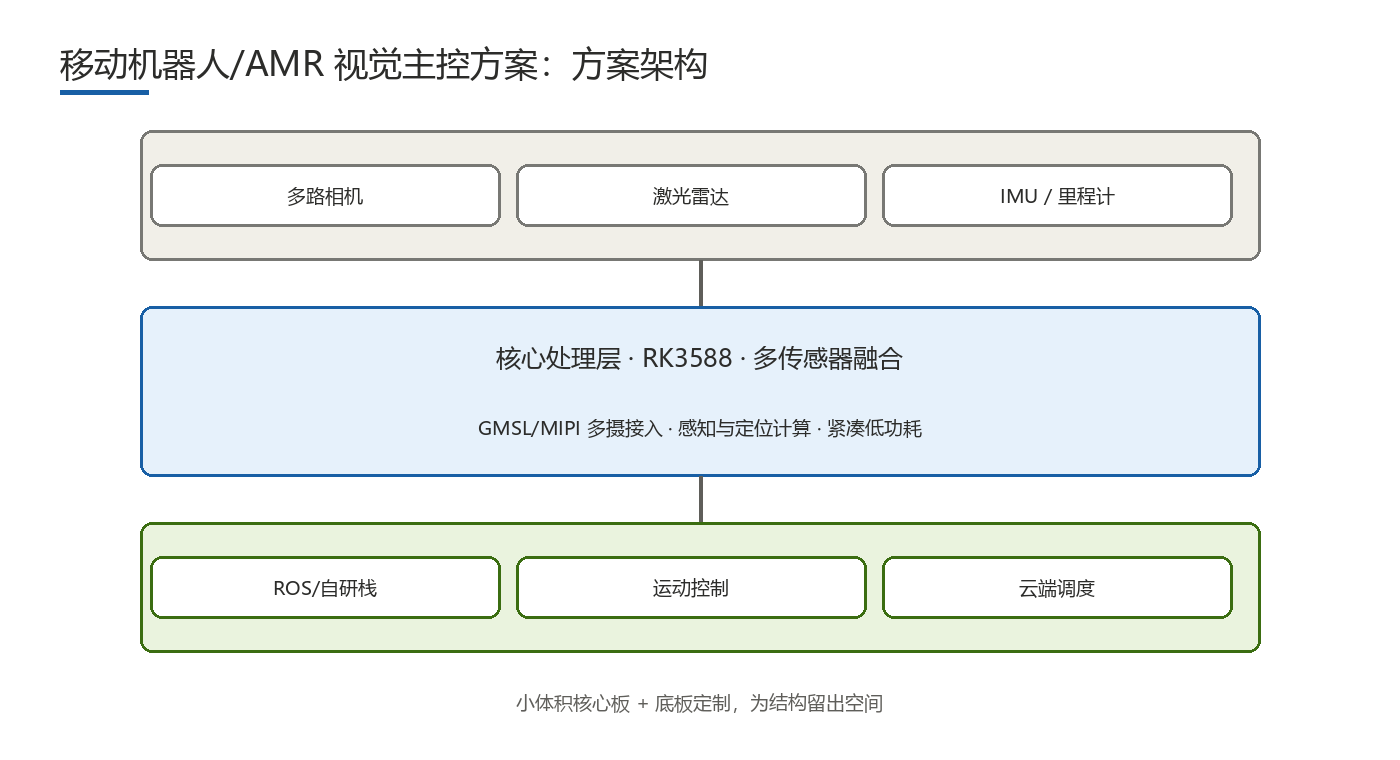
AMR and service robot vision hosts must handle perception, localization and decision-making within tight space and power budgets. Centered on the RK3588, this solution supports camera, LiDAR and IMU sensor fusion, GMSL multi-camera input and a compact low-power board design, compatible with ROS and custom algorithm stacks. Hongyin Tech engineers support you directly, with selection advice within 48 hours. Submit your requirements for a free review.
Pain Points
- Imported robot host computers are expensive with long lead times, disrupting project schedules
- Tight space and power budgets make large, heat-heavy host boards impractical inside the chassis
- Time synchronization and fusion of cameras, LiDAR and IMU carry a high development barrier
- Multi-camera input is limited by interface count, and GMSL expansion lacks mature reference designs
- A gap exists between prototype and production: dev-board solutions rarely convert directly into product hardware
Recommended Hardware Configuration
| SoC platform | RK3588 (4x A76 + 4x A55) as an integrated perception and decision vision host |
|---|---|
| AI compute | 6TOPS NPU for SLAM front-end features, obstacle detection and semantic segmentation |
| Memory & storage | LPDDR4/4x (large-memory options) + eMMC for map data and multi-stream image caching |
| Sensor input | Multi-channel MIPI CSI plus GMSL camera expansion, UART/SPI for IMU, Ethernet for LiDAR |
| Motion control I/O | CAN/RS485 to chassis control, GPIO for emergency stop and indicators |
| Power & enclosure | Compact low-power board with wide-voltage battery input and fanless cooling for in-chassis mounting |
Software Capabilities
- ROS support: Ubuntu with ROS/ROS2 environments and common sensor driver adaptation
- Sensor fusion: time synchronization across cameras, LiDAR and IMU to support SLAM and navigation stacks
- NPU vision algorithms: RKNN deployment and tuning of obstacle detection and semantic segmentation models
- Custom stack adaptation: open low-level interfaces and BSP documentation to port in-house perception and planning algorithms
- Production toolchain: batch image flashing, factory test scripts and OTA updates from prototype to volume
Deliverables & Services
- Free requirements review: sensor list, compute budget and chassis interfaces, with advice within 48 hours
- Hardware design: SoM plus custom carrier, GMSL link design and enclosure/thermal adaptation
- BSP/drivers: OS tailoring, multi-sensor drivers and time synchronization development
- Pilot integration: joint debugging with ROS or custom stacks, SLAM and navigation validation
- Volume support: low-volume ordering, batch flashing and factory testing, long-term lifecycle supply
FAQ
Q:Will SLAM and visual perception compete for resources on the RK3588?
No. Conventional SLAM computation runs on the CPU while deep-learning perception uses the 6TOPS NPU, giving natural isolation. Actual allocation depends on your algorithm stack; our engineers assist with load analysis and tuning during integration to keep both localization and perception real-time.
Q:Our algorithms are in-house without ROS. Can you still support us?
Yes. We provide complete BSP documentation and low-level interfaces, so your in-house stack can run directly on Ubuntu or Debian; we handle OS tailoring, drivers and performance tuning. The exact adaptation scope is defined during the free requirements review, with initial selection advice within 48 hours.
Q:What are the benefits of GMSL multi-camera for robots?
GMSL carries multiple HD video streams over coaxial cable, simplifying wiring and improving interference immunity, ideal for slim AMR chassis with dispersed cameras. The solution includes GMSL link design and multi-stream driver adaptation, reducing integration risk. See our GMSL solution article on the website for details.
Q:How do we transition from prototype to production?
The solution uses a production-ready SoM plus carrier architecture, so prototype and production hardware share the same source and avoid redesign when leaving dev boards. Volume phase includes batch flashing, factory test scripts and supply planning. Low-volume ordering is supported, and the production plan is confirmed with the proposal after the free review.
Related Technical Articles
Share your scenario and requirements — free requirement review, selection advice within 48 hours.
Get a Free Quote →