Docker Containerization on RK3588 Edge Devices: Field Notes
Docker containerization is a good fit for RK3588 edge devices that run multiple services or iterate frequently: applications ship as container images decoupled from the system firmware, upgrades and rollbacks happen by tag in seconds, and services stay isolated. Single-purpose devices that never change after delivery are better left in firmware.
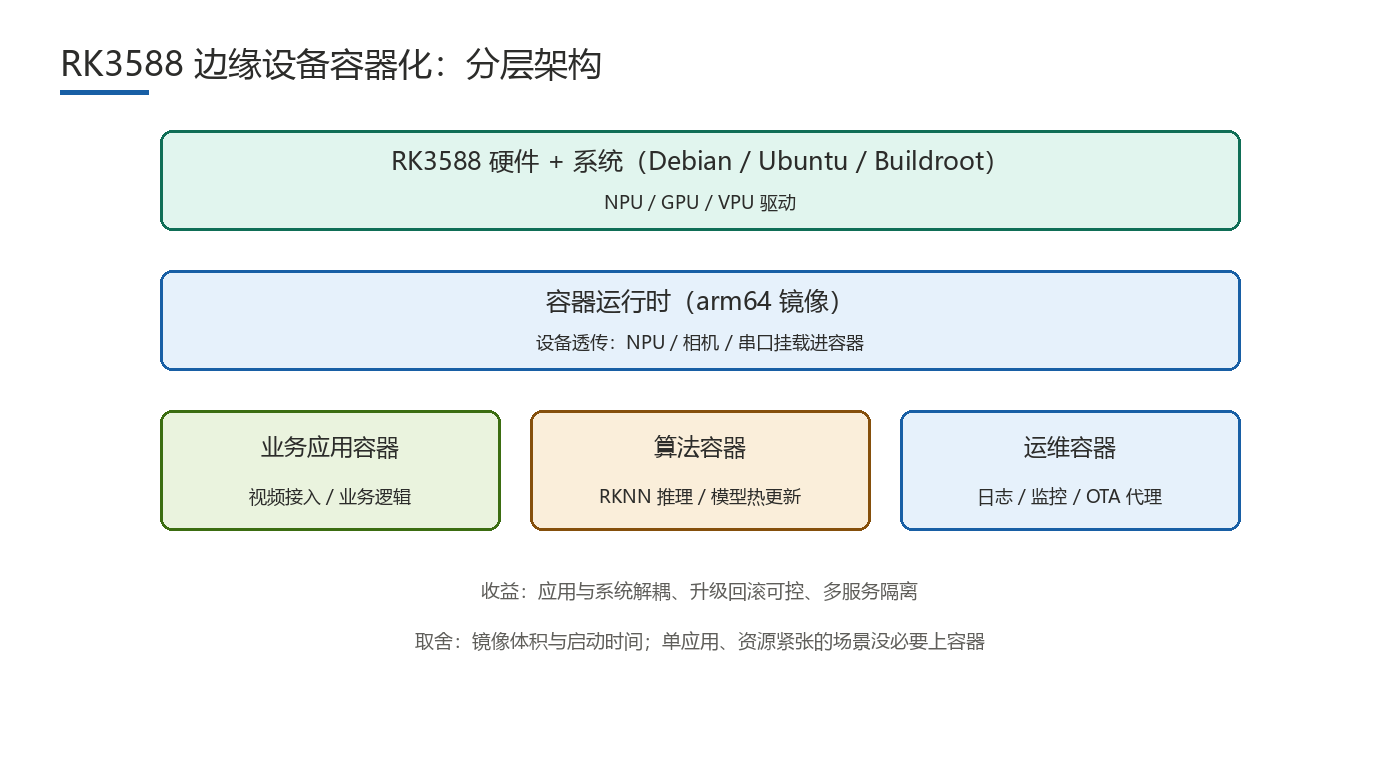
Edge software used to be baked into firmware: one line of business logic changed meant a full firmware rebuild and device-wide OTA, and version management across projects became a nightmare. Containers restructure exactly that.
Why Put Edge Applications in Containers?
- App/system decoupling: the base system stays on a stable release while business apps iterate as images on independent schedules.
- Upgrade and rollback: pulling a new tag is the upgrade; rolling back is switching tags, in seconds, without a reboot.
- Service isolation: inference, web backend, and data collectors run in separate containers with cgroup limits, so one crash does not take down the box.
What Must Be Configured to Run Containers on RK3588?
RK3588 is arm64, so official Debian/Ubuntu base images work out of the box and buildx handles cross-builds. Three prerequisites:
- Kernel config: Docker needs cgroups, namespaces, and overlayfs; some RK BSP kernels do not enable everything by default — audit against the Docker requirements checklist and rebuild if needed (per your SDK docs).
- NPU passthrough: mount /dev/rknpu into the container and install an RKNN Runtime matching the host driver version; mismatches are the most common cause of inference failures.
- GPU and display: mount /dev/dri and /dev/rga only when a container needs DRM output or RGA acceleration; keep desktop-composition logic outside containers.
How Do You Balance Image Size and Startup Time?
Edge storage is tight and field bandwidth unreliable, so image engineering matters: multi-stage builds, slim base images, and large model files mounted as volumes instead of baked in — model updates then stay independent of code updates. Containers themselves start in seconds, but AI services spend longer loading models, so health checks and ordered startup beat aggressive image shrinking. At fleet scale, run a local registry so dozens of devices are not pulling from the public internet.
How Do Containers and OTA Work Together?
They layer rather than compete: firmware OTA handles low-frequency system updates (kernel, drivers, RKNPU driver version) while container images carry high-frequency app iterations, each with independent rollback — system issues roll back the system, app issues roll back the app. App release cadence stops being hostage to firmware cycles, which is the real operational payoff.
Should Your Project Use Containers?
| Aspect | Containerized delivery | Firmware-monolithic delivery |
|---|---|---|
| Iteration | Apps release independently and often | Everything ships with firmware |
| Rollback | Switch image tag, seconds | Full-device OTA rollback |
| Overhead | Extra memory and storage | Leaner |
| Best fit | Multi-service, fast iteration, multi-model reuse | Single function, rarely changes |
For existing projects, phase it in: extract one container first to validate device passthrough and the upgrade path, then split by service boundaries with resource limits and health checks, and only then add fleet-scale registry capabilities. If progress stalls, you can always fall back to firmware delivery. New projects can design for containers from day one.
FAQ
- Q1: How do you use the NPU inside a Docker container on RK3588?Mount the /dev/rknpu device node into the container and install an RKNN Runtime that matches the host driver version; version mismatch is the most common cause of inference failures.
- Q2: Do you still need full-device OTA after containerizing?Yes. Firmware OTA updates the system and drivers at a low frequency while container images iterate the application frequently, with independent rollback per layer — the recommended layered structure.
- Q3: How do you keep edge images small?Multi-stage builds with slim base images, model files mounted as volumes rather than baked in, and a local registry for fleet distribution to ease field bandwidth.
Containerization solves one problem well: decoupling application iteration from system stability. Multi-service, fast-iterating, fleet-scale RK3588 projects benefit clearly; lean single-function devices are better in firmware. Prove a single container first, then scale — a low-risk, reversible path.
Further reading: RK3588 NPU in Practice: What Can 6 TOPS Run? Deployment and Optimization Guide, RK3588 Firmware Customization: Complete BSP to Production Firmware Process (2026), How to Choose an Edge Gateway or AI Box: From Data Forwarding to Edge Inference (2026).
Shenzhen Hongyin Technology Co., Ltd. (HONGYIN TECH) provides embedded project customization on RK3588/RK3576/RK3568 platforms — free requirement review, engineer-direct communication and low-volume ordering. Send your requirement list and receive selection advice and quotes within 48 hours.
phone +86 13728726926 | email sales@hoyin-tech.com | website www.hoyin-tech.com | address: Room 301, Building A, Fanrong Science Park, Sanwei Community, Hangcheng Street, Bao'an District, Shenzhen, China.
Hongyin Tech provides full-stack SoM/SBC customization on Rockchip & HiSilicon platforms with Android/Linux. Engineers respond within 1 business day.
Get a Free Quote →