GMSL Camera Access on RK3588: Multi-Camera Vision for Robotics and Vehicles
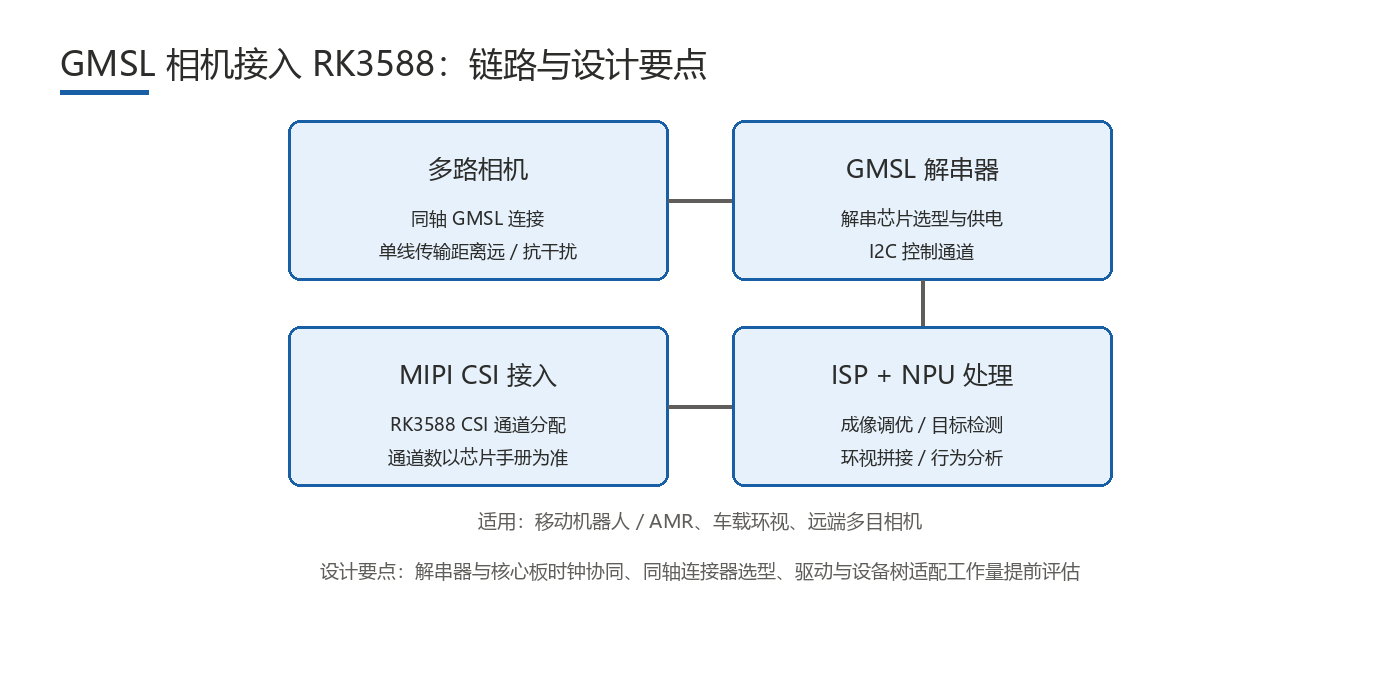
GMSL cameras connect to the Rockchip RK3588 through a serializer–coax–deserializer chain: the deserializer converts the serial stream back into MIPI CSI-2, which feeds the SoC's ISP. Compared with direct MIPI wiring, GMSL supports remote camera placement over a single coax, making it the mainstream choice for multi-camera robots and vehicle vision systems.
Why do multi-camera systems accept the extra serializer and deserializer cost? In AMRs and vehicle vision, cameras rarely come alone: surround view needs four, plus front, rear, and in-cabin cameras, and you quickly reach six to eight streams. MIPI CSI-2 is direct and low-latency, but traces should stay within roughly 20-30 cm (check the datasheet) and differential pairs need careful length matching. GMSL carries video and control over one coaxial cable, supports Power-over-Coax, reaches several meters (per device datasheets), and tolerates interference far better.
GMSL vs MIPI: How Do You Choose?
| Aspect | MIPI CSI-2 | GMSL |
|---|---|---|
| Distance | Typically within 20-30 cm | Several meters, remote mounting |
| Cable | Multiple matched differential pairs | Single coax, simple routing |
| Noise immunity | Degrades over distance | Shielded coax, robust |
| Power | Separate supply needed | PoC over the same cable |
| Cost | Lower link cost | Serializer/deserializer added |
In short: short on-board links favor MIPI; remote, multi-camera, cable-flexing environments favor GMSL, and many projects mix both. Note that GMSL link bandwidth is fixed, so the resolution × framerate × bit-depth budget per lane must be checked at design time, before prototypes are ordered.
What Does the Full GMSL-to-RK3588 Link Look Like?
Camera with built-in serializer → coax → GMSL deserializer → MIPI CSI-2 → RK3588 ISP → application. The deserializer restores the serial stream to MIPI and feeds one of the RK3588's MIPI CSI inputs. The SoC supports multiple CSI inputs with a multi-stream ISP; the exact channel count and lane allocation are defined in the SoC manual and must be confirmed early in hardware design.
Which Applications Suit GMSL Multi-Camera Systems?
- Mobile robots / AMRs: navigation and obstacle cameras around the chassis, far from the board, with cables that flex constantly — coax handles this far better than ribbon cable.
- Surround view (AVM): four fisheye cameras aggregated over GMSL, with the RK3588 stitching and displaying while perception models run in parallel.
- Remote multi-camera heads: inspection robots with separated head and body, where one coax solves video, control, and power at once.
What Hardware Design Pitfalls Should You Watch For?
- Deserializer selection: confirm channel count, per-lane resolution and framerate limits, PoC support, and pairing with the camera-side serializer (per datasheets).
- Power design: isolate and reverse-protect supplies at both ends; PoC inductor choice directly affects video quality.
- Connectors: Fakra or micro-coax types with 50-ohm impedance matching; respect the cable bend radius in the vendor spec.
- Protection: add ESD devices and common-mode filtering at cable exits, the weak point in robotic and vehicle environments.
How Much Driver and Debugging Effort Does GMSL Take?
The driver work spans three layers of I2C configuration — sensor, serializer, deserializer — with init sequences often written or adapted by hand, plus integration with the rkcif/rkisp framework. The typical debug path: verify I2C access with i2cdetect and a scope, check deserializer lock status, then validate the image path into the ISP step by step. A deserializer with a proven reference design shortens the schedule; for a fresh link, budget two to four weeks depending on complexity.
FAQ
- Q1: Can a GMSL camera connect directly to the RK3588?No. A GMSL deserializer must convert the stream to MIPI CSI-2 first; the RK3588 side is then configured as a regular MIPI camera path, with channel and lane allocation per the SoC manual.
- Q2: Can one coax carry both video and power?Yes, with Power-over-Coax: both ends must support PoC with proper networks, and inductor selection affects video quality — see the device datasheets for details.
- Q3: Where should GMSL debugging start?Confirm I2C access to all three devices, check the deserializer lock registers, then validate the image path into the ISP step by step, changing one thing at a time.
- Q4: Will four GMSL cameras saturate the RK3588 ISP?It depends on each stream's resolution and framerate. The ISP handles multiple concurrent streams, but the bandwidth budget must be sized against your actual video specs — confirm with the SoC manual and testing.
For multi-camera systems with remote placement, GMSL plus the RK3588 is a proven architecture; short on-board links are better served by direct MIPI. Confirming the bandwidth budget, deserializer choice, and driver effort up front keeps later rework low.
Further reading: RK3588 Camera Design Guide: MIPI CSI Interfaces, Multi-Camera Setups and Debugging, How to Choose Between RK3588, RK3576 and RK3568 SoMs: A Practical Selection Guide, RK3588/RK3576 New Carrier Board BSP Bring-Up Checklist: From Power-On to a Running System.
Shenzhen Hongyin Technology Co., Ltd. (HONGYIN TECH) provides embedded project customization on RK3588/RK3576/RK3568 platforms — free requirement review, engineer-direct communication and low-volume ordering. Send your requirement list and receive selection advice and quotes within 48 hours.
phone +86 13728726926 | email sales@hoyin-tech.com | website www.hoyin-tech.com | address: Room 301, Building A, Fanrong Science Park, Sanwei Community, Hangcheng Street, Bao'an District, Shenzhen, China.
Hongyin Tech provides full-stack SoM/SBC customization on Rockchip & HiSilicon platforms with Android/Linux. Engineers respond within 1 business day.
Get a Free Quote →