RK3588 as a Video Wall Decoder and Multi-Display Controller
The Rockchip RK3588 works well as a video wall decoder and splicing controller: with 8K decode capability (public specification) and multiple HDMI/DP outputs, one compact box can decode, split, composite, and drive several screens. It fits surveillance centers, meeting rooms, and exhibition halls; the exact output combinations are defined in the SoC manual.
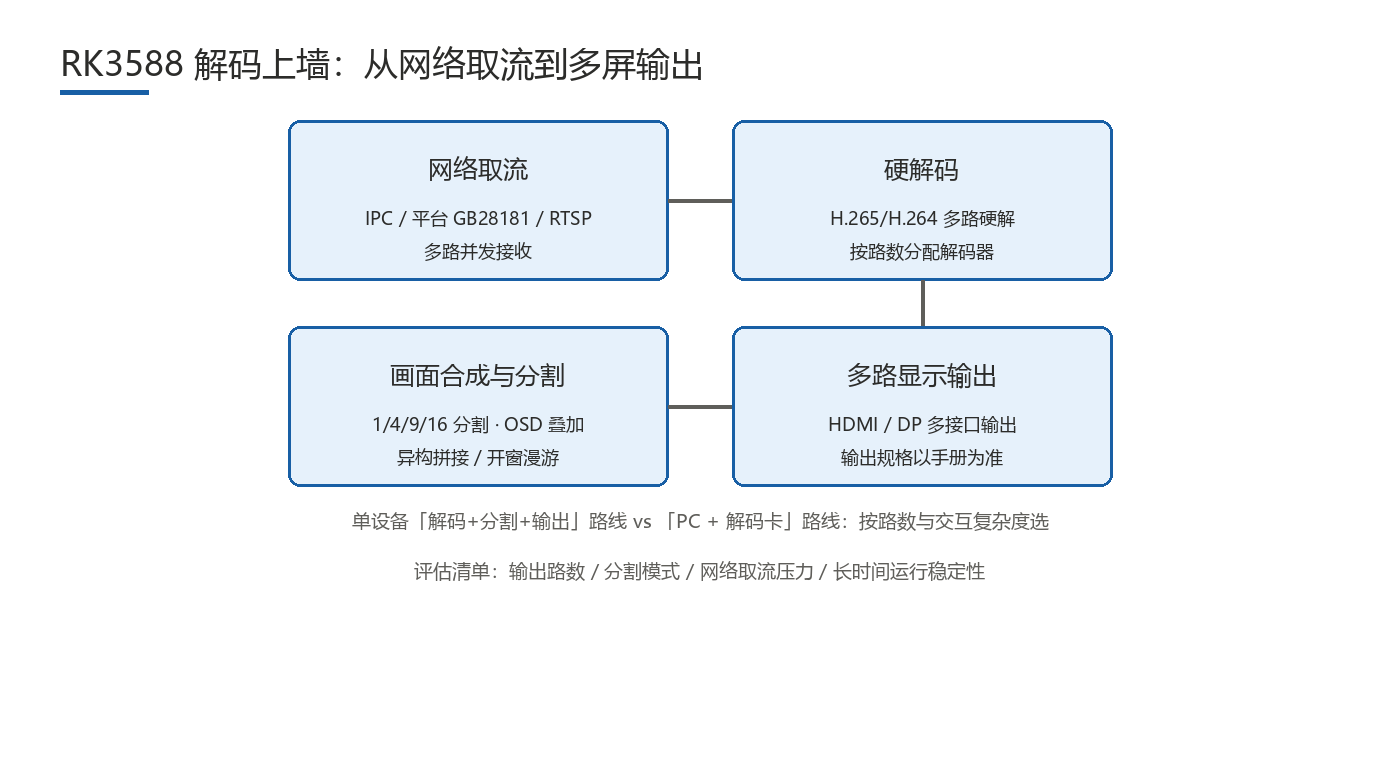
The traditional approach — an x86 industrial PC plus decoder cards — is costly, bulky, and power hungry. The RK3588 integrates multiple display controllers with HDMI and DP outputs, and when one box cannot cover every screen, a cascaded architecture takes over: each unit drives a subset of screens and pulls its own streams, while a master unit coordinates layouts. Scaling stays clean and a single failure stays local.
Why Do Control Rooms Need an Integrated Decode-and-Wall Box?
Tens of IP cameras decoded live onto 2-8 large screens, with 1/4/9/16 splits, tours, and OSD pop-ups, is the classic requirement. Folding decode, compositing, and output into one device cuts both acquisition cost and operational complexity, which explains why RK3588 boxes have been widely adopted in small and mid-size video wall projects.
How Many Screens Can One RK3588 Drive?
The display controllers support multiple outputs; port count, resolution combinations, and mirror versus independent display follow the SoC manual and determine single-box capacity. For multi-screen independent display, verify up front that the resolution combinations you need are supported simultaneously — an easy detail to miss and one that directly affects feasibility.
Single Box or PC Plus Decoder Cards?
| Aspect | Single-box decode + split + output | PC + decoder cards |
|---|---|---|
| Cost | Low unit cost, scales linearly | Cards priced per channel, costly at scale |
| Size and power | Compact, fanless possible | IPC chassis, higher power |
| Concurrency | Bounded by one SoC | Expandable via more cards |
| Development | Embedded stack, reusable across projects | Depends on Windows and card SDKs |
| Best fit | Small-to-mid walls, tens of channels | Large walls, 100+ channels |
The routes are not mutually exclusive: many projects cover regular zones with RK3588 boxes and add one traditional unit for an oversized zone, which balances cost well.
What Should the Splicing Software Stack Solve?
Compositing means placing streams of different resolutions and frame rates onto multiple output canvases, then cropping, scaling, and overlaying OSD (time, channel names, alarm boxes) per split mode. On RK platforms RGA handles hardware scaling and compositing, DRM/KMS manages layers, and the decoder is allocated per stream. Three field-tested practices:
- OSD on dedicated layers, never per-frame CPU compositing, which would eat decode headroom.
- Sub-streams by default, switching to main streams on demand and dropping frames in idle windows to keep resources where the operator is looking.
- A layout state machine decoupled from decode and render: tours involve decoder preemption and release, alarm linkage is event-driven layout — this state machine is where the real software complexity lives.
What Should You Evaluate Before Committing?
- Outputs and resolution: screen count, size, and 4K or not decide single-box versus cascade.
- Split and free-window modes: arbitrary windows and cross-screen roaming change software complexity significantly.
- Concurrent decode load: channels × bitrate × framerate, with headroom against the decode specs (per the manual).
- Network planning: switch bandwidth, multicast/unicast strategy, stream distribution.
- 24/7 stability: thermal design, watchdog, and automatic recovery.
FAQ
- Q1: How many channels can the RK3588 decode for a video wall?It depends on resolution, frame rate, and codec per stream. Public specs list 8K decode; size concurrency against your actual stream parameters and the SoC manual.
- Q2: What if the wall exceeds one box's outputs?Cascade: each unit drives a subset of screens and pulls its own streams while a master unit distributes layouts, improving scalability and fault isolation.
- Q3: Why not composite OSD on the CPU?Per-frame software compositing consumes CPU and squeezes decode capacity; dedicated hardware layers composited by RGA are the standard approach on RK platforms.
For small and mid-size walls of a few dozen channels, an RK3588 decode-and-wall box wins on cost, size, and power; 100+ channel sites still deserve a cascade or hybrid evaluation. Locking output specs and decode headroom at the design stage makes delivery far smoother.
Further reading: RK3588 Display Design Guide: HDMI, DP, MIPI-DSI, eDP and Dual-Screen Setups, How Many Camera Channels Can an RK3588 NVR Handle? Hardware Guide, Docker Containerization on RK3588 Edge Devices: Field Notes.
Shenzhen Hongyin Technology Co., Ltd. (HONGYIN TECH) provides embedded project customization on RK3588/RK3576/RK3568 platforms — free requirement review, engineer-direct communication and low-volume ordering. Send your requirement list and receive selection advice and quotes within 48 hours.
phone +86 13728726926 | email sales@hoyin-tech.com | website www.hoyin-tech.com | address: Room 301, Building A, Fanrong Science Park, Sanwei Community, Hangcheng Street, Bao'an District, Shenzhen, China.
Hongyin Tech provides full-stack SoM/SBC customization on Rockchip & HiSilicon platforms with Android/Linux. Engineers respond within 1 business day.
Get a Free Quote →