RK3588 Multi-Channel Video Capacity Planning: Decoding, Bandwidth, and Storage Sizing
How Many 4K Channels Can RK3588 Decode Simultaneously?
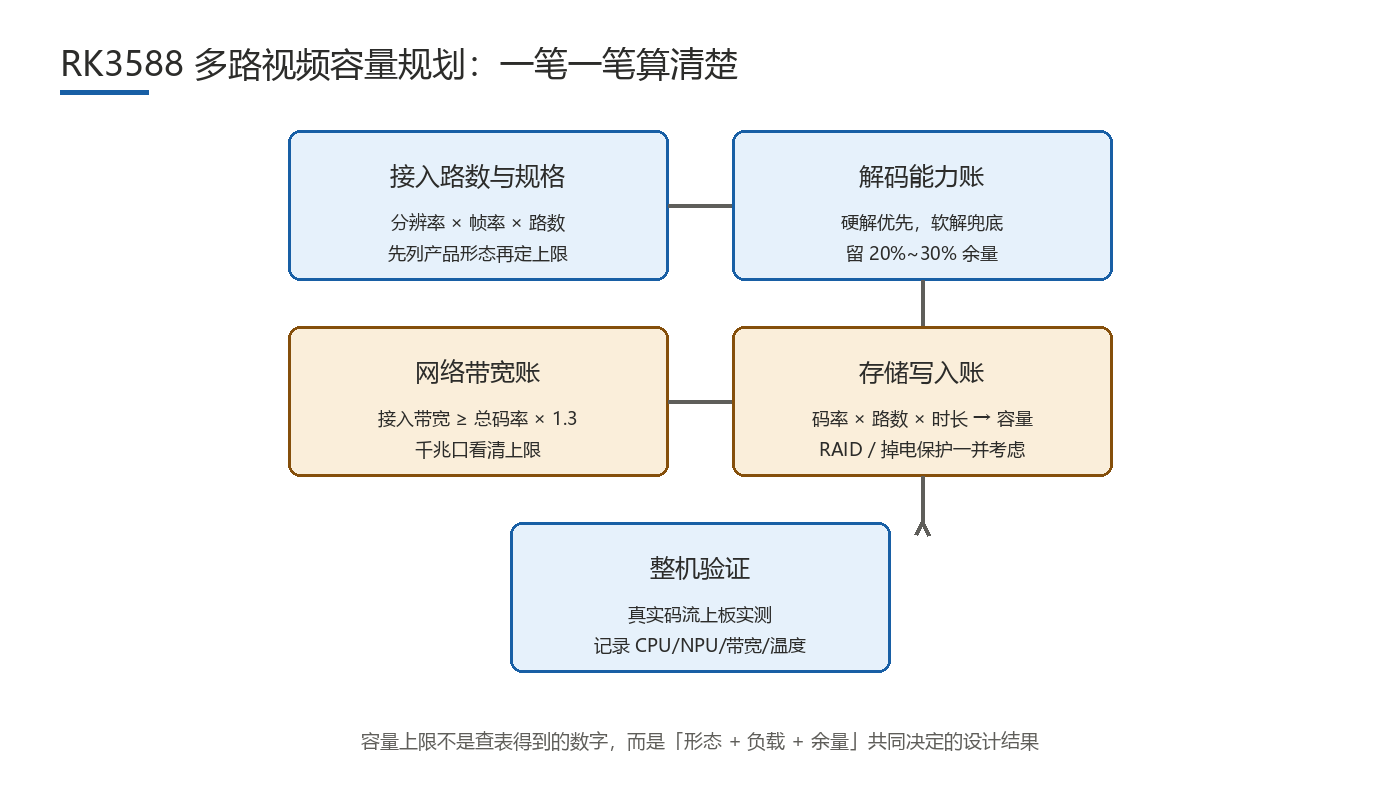
There is no fixed answer — decode capacity is a pixel-throughput budget: resolution × frame rate × channel count, minus headroom for AI inference, display output, and peak bitrates. Instead of quoting a marketing number, compute the three budgets (decode, bandwidth, storage) and close the loop with real-stream testing.
What Is the Basic Decode Math?
Per-channel decode load ≈ width × height × frame rate. One 1080p30 stream is roughly 62 million pixels per second; one 4K30 stream about 250 million — four times as much. RK3588's hardware decoder has a total throughput ceiling (8K decoding is published; per-codec limits belong in the official datasheet). Plan with 20-30% headroom for peaks and expansion.
| Stream | Pixel throughput (approx.) | Typical bitrate (H.265) | Storage per channel/day |
|---|---|---|---|
| 1080p30 | 62 Mpx/s | 2-4 Mbps | 21-42 GB |
| 1440p30 | 110 Mpx/s | 4-6 Mbps | 42-64 GB |
| 4K30 | 250 Mpx/s | 8-16 Mbps | 84-168 GB |
| 4K60 | 500 Mpx/s | 16-28 Mbps | 168-295 GB |
A handy trick for mixed workloads: convert every stream into 1080p30 equivalents — 4K30 is about 4 equivalents, 2K30 about 2 — then sum. All figures must be confirmed by measurement.
Where Is the Hard/Soft Decode Boundary?
Hardware decoding consumes almost no CPU. Cross the boundary — exotic codecs, non-standard resolutions — and software decode spikes CPU load; one high-resolution soft-decoded stream can saturate several A55 cores. Rule of thumb: primary streams always on hardware decode; software decode only for edge cases or debugging, with dedicated stress testing. Do not guess the boundary: compare CPU curves on a prototype with and without the software-decode fallback; the knee point marks it.
How Much Bandwidth and Storage Headroom?
The goal here is not digit-level precision but fixing the hardware envelope: NIC specification, drive bays, and disk type all get decided at this stage.
- Ingest bandwidth: sum of bitrates × 1.2-1.5 concurrency factor (reconnects and scene changes spike bitrates); evaluate a gigabit port at about 900 Mbps effective and confirm dual-NIC or 2.5G options at hardware selection if needed. Weight bitrates by the actual H.265/H.264 mix, and budget forwarding traffic (cascading, platform relay) separately from ingest.
- Storage capacity: GB/day = bitrate(Mbps) × 86400 ÷ 8 ÷ 1024 — a 4 Mbps channel writes about 42 GB/day; add roughly 15% on top of retention totals and account for RAID overhead.
- Write bandwidth: concurrent channels × bitrate × 1.2 peak must stay below disk capability; watch IO contention across multiple drives.
How Do NVR, All-in-One, and Analytics Box Ratios Differ?
- NVR: sub-stream preview on all channels, main-stream decode only for selected or touring channels; AI channel counts planned separately from recording counts.
- All-in-one: few decode channels but heavy display load; reserve compute for compositing and UI, typically 4-8 decode channels suffice.
- Analytics box: the NPU is the bottleneck, not decode; with 6TOPS, plan 8-16 channels of 1080p structured analytics and provision about 1.5× decode.
Whatever the form factor, write decode, analytics, and display channel counts into the spec sheet separately instead of one combined number — they share the same decoder and NPU, and a single blended figure hides contention until production.
FAQ
- Q1: How many 4K channels can RK3588 handle?No fixed figure: at roughly 250 Mpx/s per 4K30 stream and 20% headroom, single-digit 4K30 decode is typical; mixed 1080p loads scale much higher. Always validate with real streams.
- Q2: Why do my tests fall short of advertised counts?Advertised numbers assume ideal streams with no AI or display load. Real projects stack peak bitrates, inference, and UI — spec your product at measured full load plus 20%.
- Q3: How much does H.265 save over H.264?Typically 30-50% bitrate at comparable quality, cutting storage proportionally; H.265 decode is heavier, so verify hardware decode throughput for your actual codec mix.
- Q4: How much storage headroom is right?About 15% on capacity after retention totals and a 1.2× peak check on write bandwidth; validate with 72+ hours of full-load recording on a prototype before freezing the spec.
Capacity planning turns "how many channels" into three computable, testable budgets: decode throughput, ingest bandwidth, and storage writes. Estimate with formulas, reserve for peaks, and close with measurements — that is how specs survive acceptance testing.
Further reading: How Many Camera Channels Can an RK3588 NVR Handle? Hardware Guide, RK3588 NPU in Practice: What Can 6 TOPS Run? Deployment and Optimization Guide, How to Choose an Edge Gateway or AI Box: From Data Forwarding to Edge Inference (2026).
Shenzhen Hongyin Technology Co., Ltd. (HONGYIN TECH) provides embedded project customization on RK3588/RK3576/RK3568 platforms — free requirement review, engineer-direct communication and low-volume ordering. Send your requirement list and receive selection advice and quotes within 48 hours.
phone +86 13728726926 | email sales@hoyin-tech.com | website www.hoyin-tech.com | address: Room 301, Building A, Fanrong Science Park, Sanwei Community, Hangcheng Street, Bao'an District, Shenzhen, China.
Hongyin Tech provides full-stack SoM/SBC customization on Rockchip & HiSilicon platforms with Android/Linux. Engineers respond within 1 business day.
Get a Free Quote →