Smart Traffic Enforcement & Checkpoint Solution
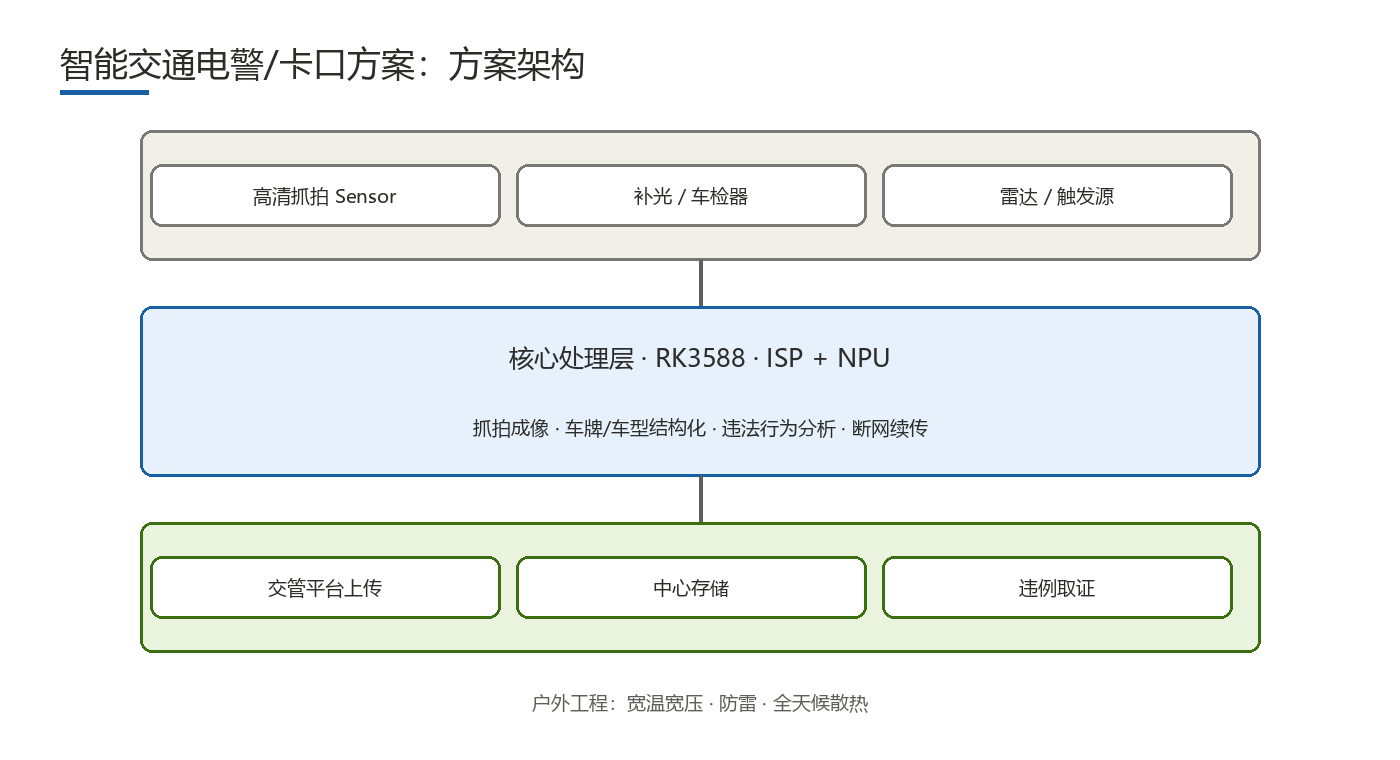
For front-end traffic scenarios such as enforcement cameras, checkpoints and radar-triggered capture, HONGYIN TECH provides an RK3588-based front-end analysis device solution. Working with HD cameras for capture imaging, it performs on-device plate recognition and vehicle structuring, buffers data locally during network outages and resumes upload after recovery, with wide-temperature, lightning-protection and ingress-protection designs for outdoor engineering. Full support from requirement review through prototype integration to small-batch delivery, with platform recommendations within 48 hours.
Pain Points
- Legacy front-end devices lack compute, pushing structuring to the back end with high bandwidth cost and recognition latency
- Harsh roadside environments cause ordinary devices to crash in summer heat and fail frequently during thunderstorm seasons
- Unstable intersection networks lose capture data during outages, leaving evidence records incomplete
- Projects require integration with existing cameras, signal controllers and platforms, making protocol adaptation work heavy and fragmented
- Traffic projects ship in volume, so suppliers must handle both engineering customization and batch quality control
Recommended Hardware Configuration
| SoC platform | RK3588 (4x A76 + 4x A55, 8K decode, 6TOPS NPU) to handle HD capture streams and parallel multi-model inference; see chipset datasheet for details |
|---|---|
| AI compute | Built-in 6TOPS NPU supporting quantized deployment and concurrent inference of plate recognition, vehicle detection and vehicle-type models |
| Video input | GbE access to HD capture cameras (RTSP or adaptable private protocols), optional direct MIPI-CSI camera connection |
| Networking & I/O | Dual GbE, optional 4G/5G, RS485 for radar/signal-controller linkage, GPIO I/O for intersection device integration |
| Storage | eMMC plus SSD expansion for capture images, structured data and network-outage buffering |
| Enclosure & thermal | Wide-temperature components and industrial thermal design targeting -40C to 85C class operation (subject to final system testing), with lightning protection and ingress-proof enclosure customized per project requirements |
Software Capabilities
- Video access and decoding: multi-channel HD stream decoding with protocol adaptation to mainstream capture cameras
- AI structuring: RKNN deployment of plate recognition and vehicle attribute models, outputting structured results on-device
- Network-outage buffering: local circular buffering of capture data with priority-based re-upload after recovery to ensure data integrity
- Linkage control: coordination with radars, signal controllers and fill lights via RS485/GPIO
- Remote O&M: device status reporting, OTA updates and log collection, adapted to traffic-industry O&M platforms
Deliverables & Services
- Free requirement review: define site scale, camera models, recognition items and integration protocols, then deliver a solution and selection proposal
- Hardware design: engineering-grade hardware with wide-temperature, lightning-protection and ingress-proof design, plus prototype builds
- BSP/driver/algorithm adaptation: OS customization, camera protocol adaptation, recognition model deployment and on-device tuning
- Prototype integration: joint debugging with customer platforms and roadside devices, with field validation and test reports
- Small-batch and volume support: low-MOQ pilot validation, batch quality consistency and sustained supply for volume delivery
FAQ
Q:Can the solution integrate with our existing capture cameras and platform?
Yes. The solution supports RTSP and mainstream camera protocols, and northbound data formats can be adapted to your platform's interface specification. Provide camera models and platform protocol documents during the free requirement review, and we will assess and propose an adaptation plan with initial recommendations within 48 hours.
Q:How does network-outage buffering work? Will data be lost?
During outages, capture images and structured data are written to local circular storage and automatically re-uploaded by priority once the network recovers. Buffer capacity is sized according to site traffic and expected outage duration; typical configurations cover extended outage windows, and exact buffering time is calculated from actual traffic during the requirement review.
Q:How are wide-temperature operation and lightning protection ensured outdoors?
Hardware uses wide-temperature-grade components with conduction cooling to reduce heat risk, while lightning protection and ingress-proof structures are customized per roadside engineering requirements. System-level high/low-temperature and ingress testing is scheduled during prototyping, with results verified by real measurements and joint field pilot validation.
Q:Traffic projects ship in volume. How do you handle capacity and quality?
The solution supports low-MOQ pilot validation followed by volume delivery on your project schedule. At volume stage we control batch consistency, keep key materials in stable supply and provide engineer-direct after-sales response for long-term operation. Detailed production scheduling can be discussed after the requirement review.
Related Technical Articles
Share your scenario and requirements — free requirement review, selection advice within 48 hours.
Get a Free Quote →