RK3588 ISP Image Tuning in Practice: WDR, Noise Reduction, and Low-Light Optimization
Why Does Image Quality Change After Switching Platforms?
On Rockchip RK3588, perceived image quality is decided by ISP tuning. Even with the same sensor, a new platform's ISP architecture, module partitioning, and tunable dimensions all differ, so legacy tuning does not transfer. Untuned default parameters typically show color casts, washed-out WDR, and different noise character — not a sensor or platform fault, just missing tuning work. Tuning toolchains also differ per platform, so budget for the learning curve alongside the schedule.
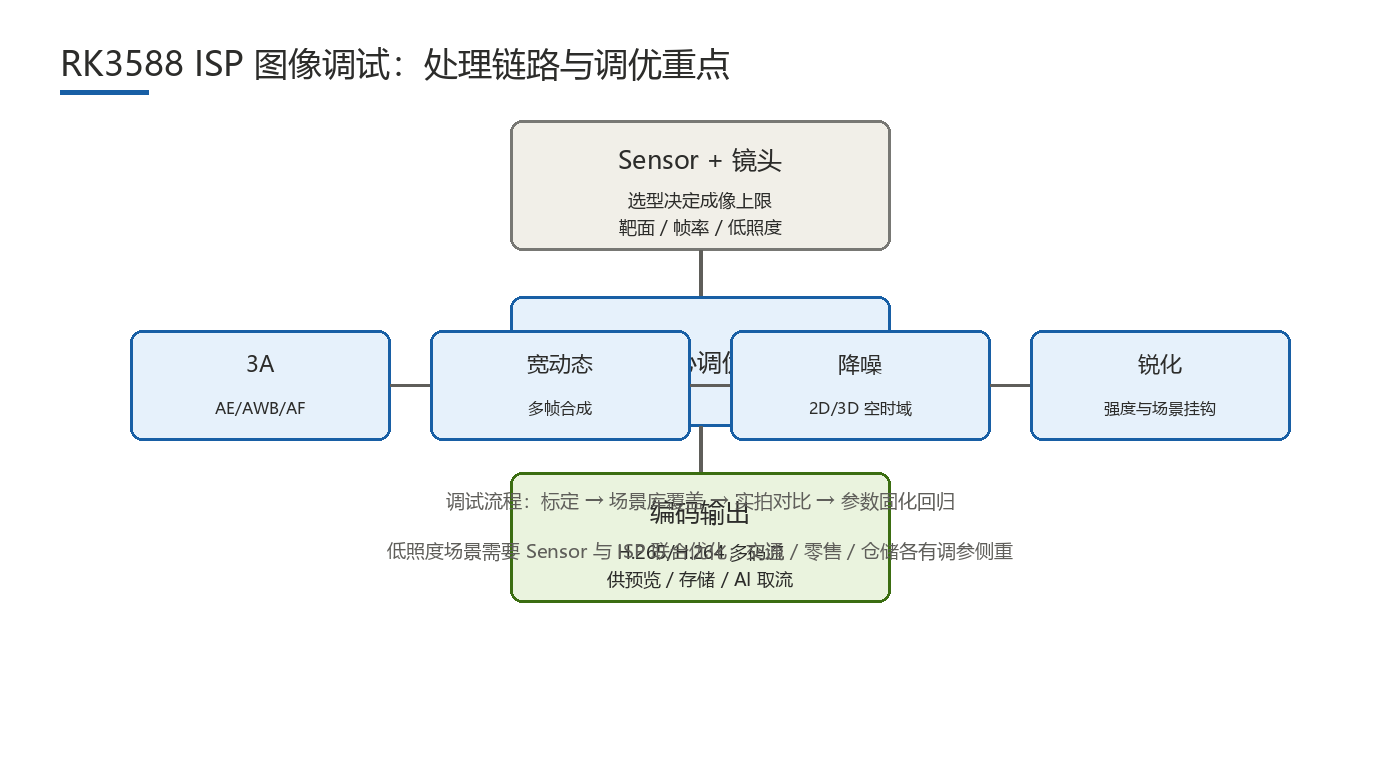
How Do You Tune WDR, Noise Reduction, and Sharpening?
- 3A (AE/AWB/AF): start with lens shading calibration, then tune AE convergence and white balance per illumination tier to avoid breathing under backlight and flickering lights.
- WDR synthesis: adjust long/short exposure ratio and blending weights; check face and sign detail under strong backlight and hunt artifacts like ghosting tier by tier.
- 2D/3D noise reduction: 2D works spatially within a frame, 3D uses temporal information; balance strength against motion smear, configured for day, night, and motion.
- Sharpening: tuned after denoising; watch edge classification and overshoot to avoid white edges and amplified noise.
Order matters: calibration first, then 3A, then WDR and denoising, sharpening last. Tuning sharpening before denoising guarantees rework — any denoise change invalidates sharpening parameters.
How Do Sensor and ISP Co-Optimize for Low Light?
Low light is a joint problem: sensor target size and sensitivity set the floor for light gathering, while ISP gain strategy, denoising, and WDR synthesis set the perceptual ceiling. Confirm sensor sensitivity, read noise, and frame-rate constraints against the official datasheet; configure denoising per gain tier so detail survives high gain; consider temporal filtering while accepting frame-rate or smear trade-offs. Define the acceptance condition first — for example, recognizable faces at 0.01 lux — then derive the parameter combination backward. A practical split: normal illumination guarantees color and detail, extreme illumination guarantees detectability.
How Much Do Sensor and Lens Choices Matter?
They set the ceiling of everything above. Align three things during selection: whether sensor size and sensitivity cover the acceptance illumination (spend here for low-light products); whether lens resolution matches the sensor pixel pitch, since weak edge resolution eats sharpening gains; and MIPI interface plus driver support against the platform BSP (per official datasheets). Time invested here repays itself during tuning; forcing a mismatched lens pushes denoise and sharpen to edge settings and degrades the result.
What Does a Solid Tuning Workflow Look Like?
Four stages: calibration (lens shading, dead pixels, color temperature) → scene library covering target illumination, dynamic range, and motion → side-by-side real-capture comparison against a reference device → parameter freeze, packaged per scene and version-controlled. Use a scoring sheet for comparison sessions — color, dynamic range, noise character, detail retention scored independently by several people — and change one parameter group per round, keeping parameter-capture mappings traceable. Emphasis differs by scenario:
| Scenario | Tuning focus | Acceptance points |
|---|---|---|
| Traffic | Plate and face detail under backlight, WDR, shutter strategy | No detail loss in daylight backlight or headlight glare |
| Retail | Skin tones, mixed-light white balance, denoise/sharpen balance | Natural skin, legible shelf text, flicker-free |
| Warehouse | Low-light denoising, motion smear control, label readability | Clean night aisles, no blur on moving objects |
FAQ
- Q1: How do I make RK3588 image quality match the old platform?No shortcuts: run the full calibration, scene library, comparison, freeze workflow, focusing on 3A, WDR, and noise character. Typically weeks to months depending on acceptance criteria.
- Q2: Night footage is noisy — sensor or ISP first?Confirm the sensor meets light-gathering and noise floors first, then tune ISP gain-tiered 3D denoising, accepting frame-rate or smear trade-offs. It is a joint optimization, not a one-sided fix.
- Q3: How much effort does ISP tuning take?Single-scene, lenient-acceptance projects finish in weeks; multi-scene projects with demanding WDR and low-light targets are measured in months and need customer-side capture reviews.
- Q4: How should tuned parameters be managed?Package per scene, version-control them, bind to firmware releases, and regress key scenes after any sensor or lens change to keep production parameters stable.
ISP tuning converts hardware capability into what customers actually see. Pick sensor and lens deliberately, tune systematically against a scene library, and manage parameters as assets — RK3588 can deliver image quality that passes acceptance.
Further reading: RK3588 Camera Design Guide: MIPI CSI Interfaces, Multi-Camera Setups and Debugging, Hi3559A Platform Status: Migration Assessment under Changing Security SoC Supply Conditions, What Is the RK3576 Good For? The Cost-Effective Choice for Mid-High Edge Scenarios (2026).
Shenzhen Hongyin Technology Co., Ltd. (HONGYIN TECH) provides embedded project customization on RK3588/RK3576/RK3568 platforms — free requirement review, engineer-direct communication and low-volume ordering. Send your requirement list and receive selection advice and quotes within 48 hours.
phone +86 13728726926 | email sales@hoyin-tech.com | website www.hoyin-tech.com | address: Room 301, Building A, Fanrong Science Park, Sanwei Community, Hangcheng Street, Bao'an District, Shenzhen, China.
Hongyin Tech provides full-stack SoM/SBC customization on Rockchip & HiSilicon platforms with Android/Linux. Engineers respond within 1 business day.
Get a Free Quote →