Smart Livestock Farm Environment and Behavior Monitoring Solution
Livestock monitoring can start with one on-site RK3576 edge terminal: it reads temperature, humidity, ammonia, CO2 and light over RS485/Modbus, links fans, cooling pads and vents to thresholds, pre-screens huddling, immobility and abnormal lying from video, and aligns weighing and feeding data with the environment curves. Readings are buffered during outages and backfilled when 4G recovers. Detection is an aid only — anomalies need manual review — and no survival rate or feed conversion figures are promised. Hongyin Tech offers a free requirement review and complete-terminal customization, with selection advice within 48 hours.
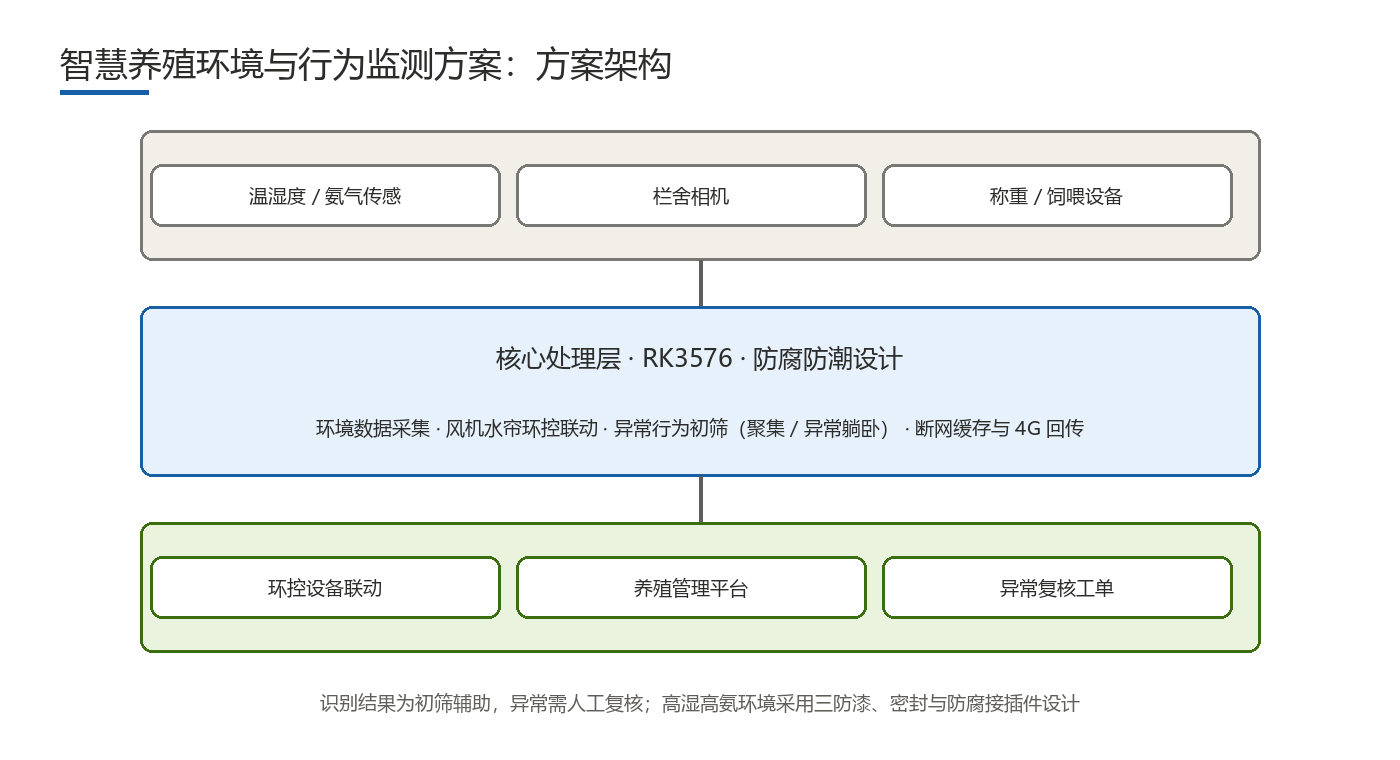
Pain Points
- Temperature, humidity and ammonia swing widely in barns, and manual fan and cooling-pad switching often comes too late
- Low patrol frequency means deaths, huddling and reduced feeding are found a day or two later
- Farms sit in remote locations where wired networks are hard to lay and in-barn wireless signals attenuate sharply
- High humidity and ammonia corrode circuits and connectors, shortening device life noticeably
- Climate control, weighing and feeding data remain separate, with no comparison on a shared timeline
Recommended Hardware Configuration
| SoC platform | RK3576 (4×Cortex-A72 + 4×Cortex-A53) running Linux for always-on duty; refer to the datasheet for details |
|---|---|
| AI computing power | 6TOPS NPU for pre-screening abnormal behavior in barn video, with results passed to manual review |
| Memory & storage | Optional LPDDR4/LPDDR5 with eMMC plus expansion, retaining environment curves, snapshots and offline buffers |
| Video input | USB cameras and RTSP network cameras streamed per barn zone, with local snapshots and short clip retention |
| Network & interfaces | RS485/RS232 for sensors and climate controllers, DI/DO for fan and cooling-pad linkage, with 4G cellular and Ethernet options |
| Enclosure & protection | Sealed moisture-proof enclosure with conformal coating, corrosion-treated connectors and wide-temperature design; ingress rating depends on mounting location |
Software Capabilities
- Environment acquisition: polls temperature, humidity, ammonia, CO2 and light sensors at minute-level intervals, filtering and flagging abnormal values
- Climate linkage: drives fans, cooling pads and vents against thresholds and hysteresis bands, with a minimum run time to reduce frequent switching
- Video pre-screening: detects huddling, prolonged immobility and abnormal lying locally, captures snapshots and routes results to manual review
- Data aggregation: ingests weighing and feeding records and aligns them with environment curves on one timeline for a traceable barn view
- Offline buffering: writes readings, alarms and snapshots to local storage, then backfills in time order with integrity checks once 4G recovers
Deliverables & Services
- Requirement review (free): map barn zones, sensor and climate equipment lists, camera points and on-site network conditions
- Hardware design: core board selection, carrier board customization, moisture and corrosion protection, and sensor power design
- BSP/drivers/algorithms: serial and IO driver adaptation, environment acquisition services and behavior pre-screening model deployment
- Prototype integration: on-site installation, climate linkage tuning, weak-network and offline validation, and platform data verification
- Low-volume and mass-production support: low MOQ, batch consistency and remote firmware upgrade maintenance
FAQ
Q:Which platform fits livestock environment and behavior monitoring?
For small and mid-sized sites focused on environment acquisition, climate linkage and light video pre-screening, RK3576 (4×A72 + 4×A53, 6TOPS NPU) is a good fit, with one unit covering a barn zone's acquisition and linkage. For many cameras across multiple houses with real-time analysis, evaluate RK3588, or deploy RK3576 per house and aggregate at the farm platform; refer to the datasheet for interface and codec channel details.
Q:What makes up the cost of a livestock environment monitoring solution?
Four parts dominate: sensors and climate-control retrofit, terminal hardware, camera points and software integration. Sensor count and whether corrosion-resistant or explosion-proof models are needed affect front-end cost; the number of houses and cameras determines terminal count and network design; integrating with a farm management system or third-party platform adds development. Start with a free requirement review and a per-house list before estimating — no inflated pricing.
Q:Farms have poor networks and humid, ammonia-rich barns — how is the hardware deployed?
Design the network wired-first with 4G backup; in low-signal houses add wireless access points or switch to cable with fiber transceivers, while local buffering keeps curves and snapshots intact during outages. Use sealed enclosures, conformal coating and corrosion-resistant connectors, mount away from wash-down zones and air outlets, and form drip loops in cabling. Final ingress rating and mounting are confirmed during prototype testing on site.
Q:Can video detection confirm deaths directly, and how should the data be used?
No — it cannot make that determination. The system pre-screens huddling, prolonged immobility and abnormal lying and captures snapshots as patrol prompts, and anomalies require manual confirmation; detection is an aid and does not replace husbandry management. The solution promises no production figures such as survival rate or feed conversion ratio; it places environment, feed intake, weighing and behavior data on one timeline to support management decisions.
Related Technical Articles
Share your scenario and requirements — free requirement review, selection advice within 48 hours.
Get a Free Quote →