RK3576 for Lightweight Edge AI: When a Flagship SoC Is Not the Right Answer
For one- to two-stream video analytics, low-power 24/7 operation, and cost-sensitive rollouts, the Rockchip RK3576 is often the better tier: 4x Cortex-A72 plus 4x Cortex-A53 with a 6TOPS NPU (public specs). Its NPU sits in the same class as the Rockchip RK3588's, so inference is not compromised; the gaps are CPU peak performance and multi-display — exactly what light workloads rarely use.
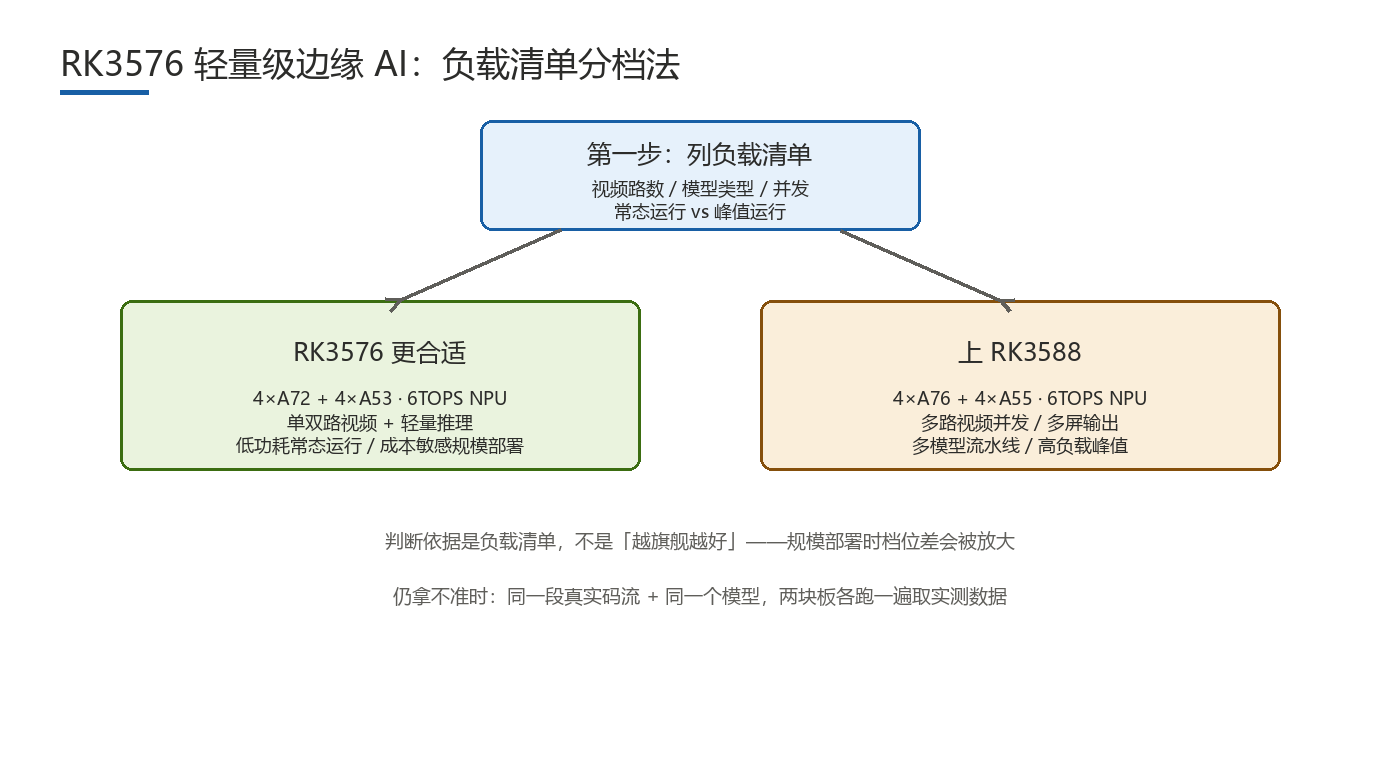
A common habit in edge AI selection: the RK3588 is the flagship, so default to it and nothing can go wrong. But for light loads, the 8-core CPU, wide memory bandwidth, and multi-display capability sit idle while you pay for them in BOM and power — and across a rollout of hundreds of units, that difference compounds into real budget. The RK3576 exists precisely for this tier.
Where Do RK3576 and RK3588 Sit in the Lineup?
| Aspect | Rockchip RK3576 | Rockchip RK3588 |
|---|---|---|
| CPU | 4x Cortex-A72 + 4x Cortex-A53 | 4x Cortex-A76 + 4x Cortex-A55 |
| NPU | 6TOPS | 6TOPS |
| Inference fit | Comfortable for 1-2 stream analytics | Multi-stream, multi-model stacks |
| Typical form | Low-power always-on boxes | High-throughput gateways, multi-display units |
The above reflects public information; confirm details against the SoC manuals. The NPUs are in the same class, so inference capability is not the differentiator — CPU peak performance, memory bandwidth, and display outputs are.
How Do You Tier Between RK3576 and RK3588?
Use a workload checklist instead of arguing over spec sheets. List what the device must sustain long-term and walk it:
- AI load: streams, resolution, concurrent models? Up to 2x 1080p or 1x 4K, the RK3576 NPU is sufficient; multi-stream stacks need a utilization and framerate headroom check.
- CPU load: transcoding, databases, protocol conversion at volume — lean RK3588.
- Display load: single-screen preview fits RK3576; multi-output leans RK3588.
- Network throughput: high-throughput gateway or multi-stream forwarding — lean RK3588.
Mostly light items point to the RK3576; two or more heavy items point to the flagship. This turns selection from spec comparison into workload verification, which is far harder to get wrong.
Which Scenarios Favor RK3576?
- One- to two-stream analytics: capture, structuring, and zone-intrusion detection on 1-2x 1080p; the NPU runs one or two models with room to spare.
- Low-power continuous operation: battery-powered and always-on boxes, where every watt saved simplifies thermal and power design.
- Cost-sensitive rollouts: campus perimeter or hard-hat detection at hundreds of units, where per-unit savings multiply.
- Single AI task plus light business logic: inference plus protocol parsing and reporting, without heavy CPU work.
A concrete example: a campus perimeter box running human detection on 2x 1080p, reporting JSON results to a platform, keeping seven days of snapshots locally, with a single debug preview screen. Walk the checklist — two AI streams, encode-and-upload CPU load, one display, modest throughput — every item lands light, and the RK3576 is the clear answer. Add 4x structured analytics plus a local 4K preview, and the same logic moves you to the flagship.
Does the Lighter Tier Cost You the Software Ecosystem?
No. Both chips share the Rockchip ecosystem: the RKNN toolchain, SDK framework, and driver stack carry over, and model conversion flows are identical. RKNN models generally deploy across both chips (per toolchain version compatibility), so deriving a lighter variant from a flagship project — or upgrading platforms later — reuses most software assets. The correction cost of a wrong tier choice is lower than most teams expect.
FAQ
- Q1: Is the RK3576 NPU the same as the RK3588's?Public specifications list 6TOPS for both, so inference capability is on par; the differences are CPU peak performance, memory bandwidth, and display outputs — confirm with the SoC manuals.
- Q2: Is the RK3576 enough for one- or two-stream analytics?Yes for 1-2x 1080p capture, structuring, and zone-intrusion detection: the 6TOPS NPU runs one or two models with headroom, provided the CPU side has no transcoding-class tasks.
- Q3: Is migrating from RK3588 to RK3576 expensive?No. The RKNN toolchain and SDK framework are shared, and models usually port directly (per toolchain compatibility), keeping migration cost low.
For light, always-on, large-scale edge AI, the RK3576 is the rational tier; multi-stream, high-throughput, multi-display projects justify the flagship. Walking a workload checklist beats guessing from spec sheets every time.
Further reading: What Is the RK3576 Good For? The Cost-Effective Choice for Mid-High Edge Scenarios (2026), How to Choose Between RK3588, RK3576 and RK3568 SoMs: A Practical Selection Guide, RK3588 NPU in Practice: What Can 6 TOPS Run? Deployment and Optimization Guide.
Shenzhen Hongyin Technology Co., Ltd. (HONGYIN TECH) provides embedded project customization on RK3588/RK3576/RK3568 platforms — free requirement review, engineer-direct communication and low-volume ordering. Send your requirement list and receive selection advice and quotes within 48 hours.
phone +86 13728726926 | email sales@hoyin-tech.com | website www.hoyin-tech.com | address: Room 301, Building A, Fanrong Science Park, Sanwei Community, Hangcheng Street, Bao'an District, Shenzhen, China.
Hongyin Tech provides full-stack SoM/SBC customization on Rockchip & HiSilicon platforms with Android/Linux. Engineers respond within 1 business day.
Get a Free Quote →