IoT Edge Computing Gateway Solution
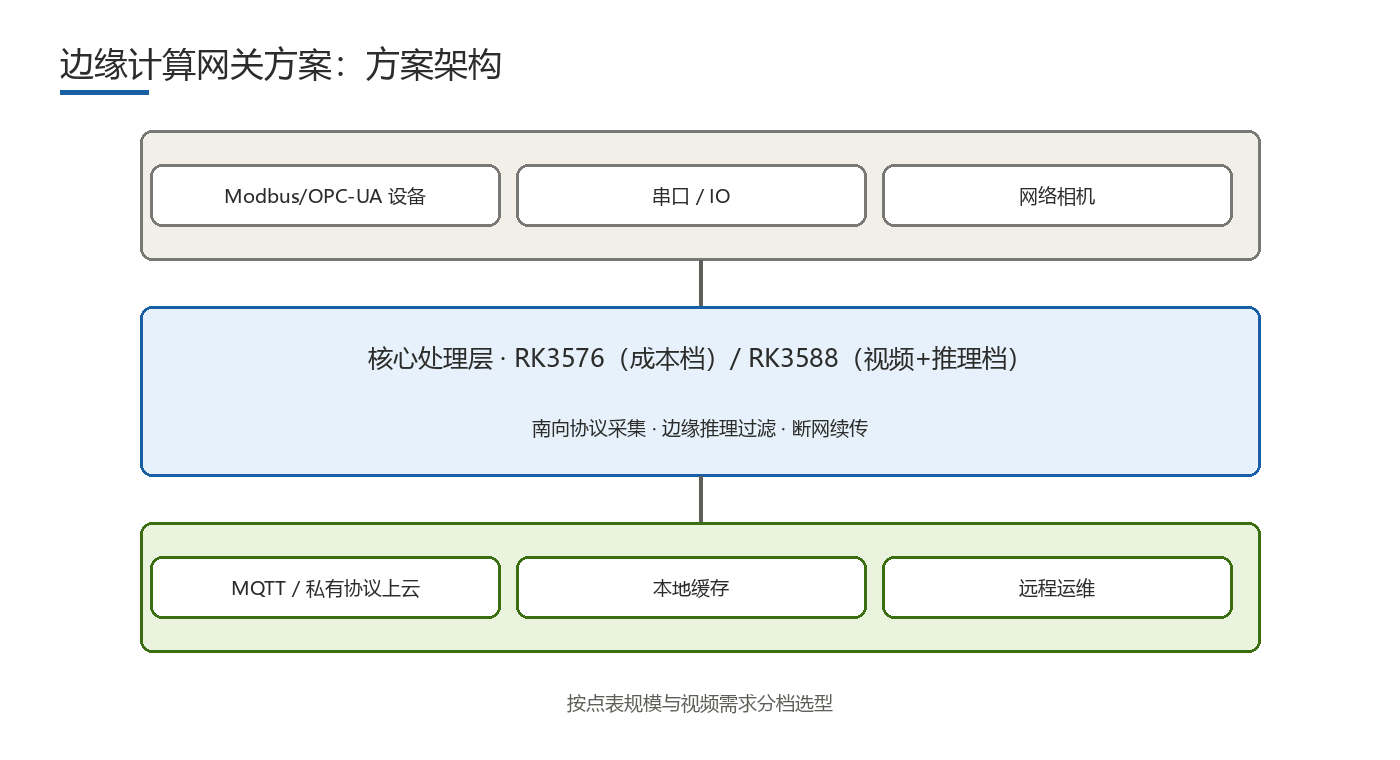
For energy, manufacturing, building and agricultural IoT projects, HONGYIN TECH offers a tiered edge gateway solution: the RK3576 platform serves the cost tier for protocol acquisition and lightweight edge computing, while RK3588 handles the performance tier for video input and AI inference. Southbound it connects PLCs, meters and sensors; northbound it uploads over MQTT/HTTP, with local buffering during outages. The unit supports I/O customization and low MOQ, with platform recommendations within 48 hours after a free requirement review.
Pain Points
- Field devices speak a zoo of protocols across Modbus, PLCs and meters, making acquisition development heavy and hard to maintain
- Gateways that only pass data through cannot filter or process at the edge, inflating cloud bandwidth and compute costs
- Unstable networks at remote sites lose data during outages, leaving cloud dashboards and traceability incomplete
- Some projects need camera input and local AI, which ordinary gateways cannot handle at all
- Project scales vary widely, so a single gateway spec is either overkill or insufficient, making cost optimization hard
Recommended Hardware Configuration
| SoC platform | RK3576 (4x A72 + 4x A53, 6TOPS NPU, cost tier) or RK3588 (4x A76 + 4x A55, 8K decode, video + inference tier); see chipset datasheet for details |
|---|---|
| Networking & I/O | Multiple GbE ports, multiple RS485/RS232 serial ports, DI/DO, optional CAN, Wi-Fi/BT, and optional 4G/5G for field networking |
| Video input | The RK3588 tier supports IP cameras (RTSP) and MIPI-CSI input for visual inspection and safety monitoring scenarios |
| AI compute | Both tiers include a 6TOPS NPU: RK3576 for lightweight inference, RK3588 for concurrent multi-model and video structuring workloads |
| Storage | eMMC storage plus expandable SSD/TF card for outage buffering, models and historical data |
| Enclosure & thermal | DIN-rail/wall-mount metal enclosure with fanless cooling and wide-temperature components for power rooms and outdoor cabinets |
Software Capabilities
- Southbound acquisition: Modbus RTU/TCP, common PLC protocols and sensor access, extensible per project
- Edge computing: data cleansing, aggregation, rule engines and local linkage control to reduce upstream traffic
- Edge inference: RKNN model deployment for local AI such as meter reading, anomaly detection and visual inspection
- Network-outage buffering: local time-series caching with automatic re-upload after recovery to ensure cloud data integrity
- Northbound cloud: MQTT/HTTPS integration with mainstream IoT platforms, plus edge-cloud collaborative remote configuration and OTA
Deliverables & Services
- Free requirement review: capture device lists, protocol types, AI needs and target cloud platform, then deliver platform-tier and specification proposals
- Hardware design: gateway hardware, I/O configuration, DIN-rail/wall-mount structure and thermal design
- BSP/driver/protocol-stack adaptation: OS customization, serial and Ethernet drivers, southbound protocol stacks and AI model deployment
- Prototype integration: joint debugging with field devices and customer cloud platform, with measured validation of acquisition and outage buffering
- Small-batch and volume support: low MOQ, batch consistency control and long-term supply
FAQ
Q:How do I choose between the RK3576 and RK3588 gateway tiers?
For pure protocol acquisition, rule computation and lightweight inference, choose the RK3576 cost tier; for camera input, visual inspection or concurrent multi-model workloads, choose the RK3588 tier. Both tiers carry a 6TOPS NPU, and you can start at one tier knowing the software stack carries over on upgrade. Submit your requirements and get recommendations within 48 hours.
Q:We have private-protocol devices on site. Can they be integrated?
Yes. Common standard protocols (Modbus, mainstream PLCs) are built in, while private protocols can be handled by sharing the protocol documents during the free requirement review; we assess and develop custom acquisition drivers as part of the project delivery plan.
Q:Can outage buffering guarantee no data loss?
During outages the gateway writes data to local time-series storage and automatically re-uploads in chronological order after recovery. Buffer duration depends on storage configuration and acquisition frequency; buffer capacity is sized from actual outage duration and data volume during the requirement review to cover the real outage window.
Q:How is device management handled for fleet gateway deployment?
The solution integrates with mainstream IoT platform device-management capabilities or can be customized to your platform's interfaces: batch registration, remote configuration, OTA updates and health monitoring are all managed centrally from the cloud, with engineer-direct support for platform integration.
Related Technical Articles
Share your scenario and requirements — free requirement review, selection advice within 48 hours.
Get a Free Quote →