Community High-Altitude Throwing Detection Solution
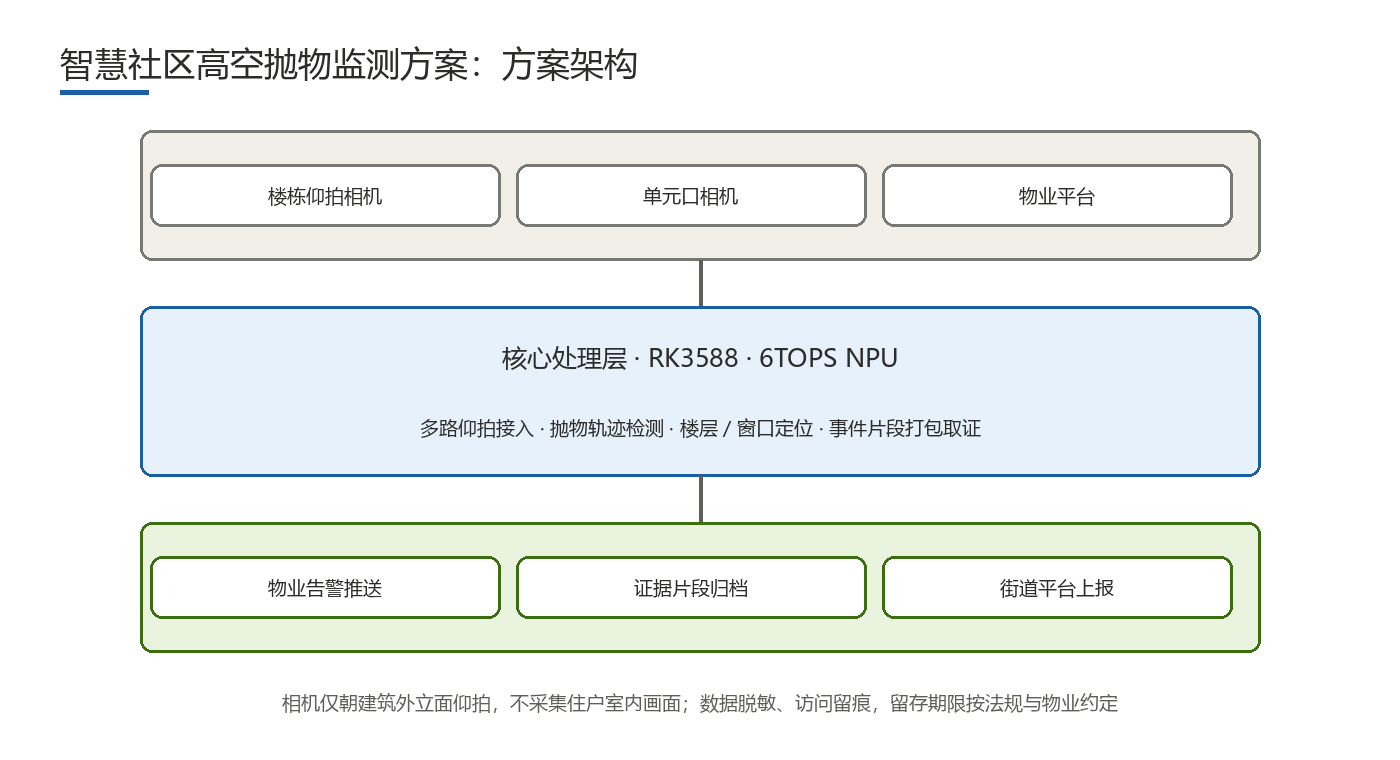
High-altitude throwing monitoring relies on upward-facing cameras plus edge compute to trace trajectories. The RK3588 platform combines 4×A76 + 4×A55 cores with a 6TOPS NPU, ingests multiple upward-facing streams, tracks falling objects, maps them to a floor and window, and retains pre/post-event clips. Cameras face the facade only and never capture interiors; footage is masked, exports are logged, retention follows regulations and property agreements, and detection is an evidence aid only. Hongyin Tech offers a free requirement review and complete-device customization, with selection advice within 48 hours.
Pain Points
- A throw lasts seconds, is hard to spot manually, and the matching footage is often missing afterwards
- Frames lack floor references, making it hard to tell which floor and window an object came from
- Low night light and strong daytime backlight leave ordinary cameras unable to capture the fall clearly
- Upward-facing cameras raise resident privacy concerns and compliance or complaint risk for property teams
- Leaves, birds and hanging laundry trigger false alarms, so property teams gradually stop using the system
Recommended Hardware Configuration
| SoC platform | RK3588 (4×Cortex-A76 + 4×Cortex-A55); refer to the datasheet for details |
|---|---|
| AI computing power | 6TOPS NPU with parallel inference on multiple upward-facing streams and trajectory-tracking model deployment |
| Memory & storage | LPDDR4/LPDDR5 with eMMC, retaining pre/post-event clips locally with loop overwrite |
| Video input | GMSL/MIPI or Ethernet IP camera input with synchronized upward-facing channels; channel count per the datasheet |
| Network & interfaces | Gigabit Ethernet with 4G backup, optional PoE power and relay output for sound-light devices |
| Enclosure & protection | Outdoor rain- and dust-resistant enclosure with wide-temperature and surge protection; mounting angle calibrated for facade coverage (IP rating per device testing) |
Software Capabilities
- Multi-channel upward-facing input: manages facade cameras by building group, with frame stitching and floor-scale overlay
- Throwing trajectory detection: continuous-frame tracking of falling objects, mapped to floor and window through calibration, producing a trajectory chart
- Event replay and evidence packaging: keeps pre-event and post-event clips and builds an evidence package with time, location and trajectory
- Privacy protection: facade-only coverage, interior masking, masked exports and logged operator and approval records
- Platform integration: pushes events, statistics and device status to property and sub-district platforms per their specifications
Deliverables & Services
- Requirement review (free): map building facades, camera count and coverage angles, then deliver privacy compliance and selection advice
- Hardware design: core board selection, carrier board customization, outdoor enclosure, power and surge protection design
- BSP/drivers/algorithms: multi-camera driver adaptation, trajectory model deployment and a floor-calibration tool
- Prototype integration: on-site mounting angle adjustment, night and backlight image tuning, false-alarm suppression and platform integration
- Low-volume and mass-production support: low MOQ, batch calibration parameter rollout and remote firmware upgrade maintenance
FAQ
Q:Should high-altitude throwing detection use RK3588 or RK3576?
Trajectory tracing depends on synchronized multi-channel video, so RK3588 with 4×A76 + 4×A55 cores and a 6TOPS NPU suits multiple channels per building, while RK3576 works for fewer buildings and low channel counts. Camera interfaces can be GMSL/MIPI or IP, with channel counts per the datasheet. Share your building and channel plan for free selection advice within 48 hours.
Q:False alarms are common in throwing detection — how are they reduced?
False alarms come mainly from leaves, birds, hanging laundry and camera shake. The solution applies multi-condition judgment using trajectory continuity, falling acceleration and object size, excludes static interference with floor-scale references, and allows time-based sensitivity adjustment. On-site calibration is required after installation, thresholds are agreed by the property team and integrator, and no fixed accuracy figure is promised.
Q:Will upward-facing cameras capture interiors, and how is privacy compliance met?
Cameras point only at the facade and never capture interiors, and mounting angles are fixed and documented during the survey. Interior window areas are masked, event exports are de-identified with operator and approval logs retained, and access is role-based; retention follows regulations and property agreements. Detection is an evidence aid only, with formal determination handled by the property team and authorities under due process.
Q:How are cost and implementation effort estimated for a throwing detection project?
Cost depends mainly on building count, camera channels and mounting height, pole and power installation, calibration effort, and how many property or sub-district platforms must be integrated. Power and cabling conditions in older communities often determine construction difficulty. Start with a free requirement review and site survey; we estimate against the actual configuration without inflating price or schedule.
Related Technical Articles
Share your scenario and requirements — free requirement review, selection advice within 48 hours.
Get a Free Quote →