Commercial Vehicle DMS and ADAS Smart Terminal Solution
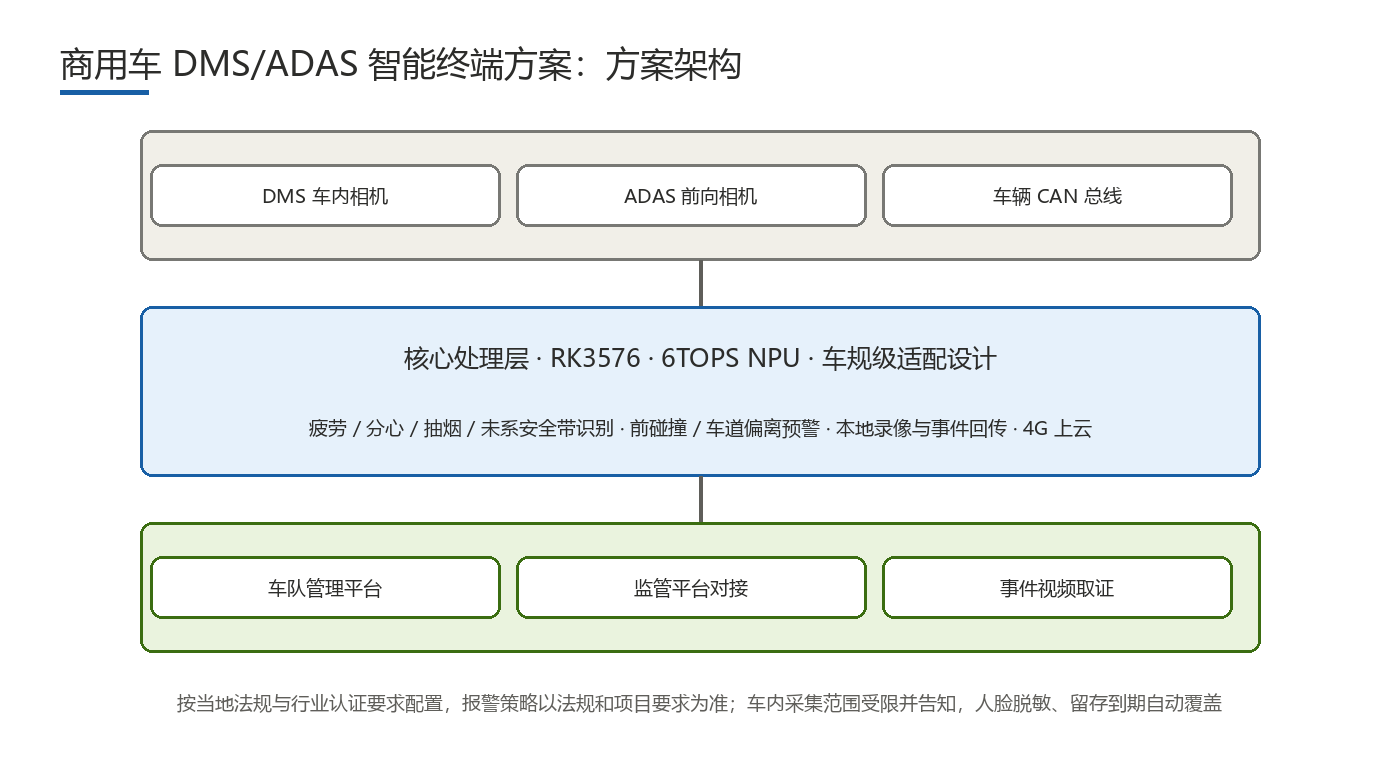
A commercial vehicle DMS/ADAS terminal built on RK3576 keeps recognition on board: the driver camera detects fatigue, distraction, smoking, phone use and seatbelt status, the forward camera warns of collision, lane departure and short headway, and the 6TOPS NPU runs both model sets, uploading only locked event clips over 4G. It reports to fleet and regulatory platforms, with alarm tiers set by route. Hongyin Tech offers a free review and complete-terminal customization, with selection advice within 48 hours.
Pain Points
- Regulations and industry rules require DMS/ADAS, yet functional scope and evidence requirements are easily misread
- Recognition stability drops at night, in backlight, and with masks, sunglasses or occlusion
- Coarse alarm rules produce frequent false alerts, prompting driver pushback or even camera blocking and power disconnection
- Multiple cameras and local loop recording concentrate storage and thermal load inside the cab
- Fleet and regulatory platforms must both be integrated, each with its own protocol and data fields
Recommended Hardware Configuration
| SoC platform | RK3576 (4×Cortex-A72 + 4×Cortex-A53) for continuous in-vehicle duty; refer to the datasheet for details |
|---|---|
| AI computing power | 6TOPS NPU with time-shared scheduling for DMS and ADAS models, supporting quantization and over-the-air model updates |
| Memory & storage | Optional LPDDR4/LPDDR5, eMMC for the system plus TF card or SSD for loop recording, sized by retention days |
| Video input | Multi-channel MIPI CSI cameras; the driver camera uses IR illumination and wide dynamic range, and the forward lens is chosen by mounting height |
| Network & interfaces | 4G cellular and Wi-Fi, with CAN/RS232/GPIO for vehicle speed, steering, braking and reverse signals, plus GNSS positioning |
| Enclosure & protection | Automotive wide-voltage input, vibration-resistant thermal design and wide-temperature range; ingress rating and certifications follow vehicle and project requirements |
Software Capabilities
- DMS detection: identifies eye closure, yawning, gaze deviation, smoking, phone use and seatbelt status, triggering tiered voice prompts
- ADAS assistance: issues forward collision, lane departure and short-headway warnings, using speed and steering signals to suppress invalid alerts
- Local recording: multi-channel loop recording with automatic locking of pre- and post-event clips so they are not overwritten
- Event upload: pushes snapshots and short clips by alarm level, queuing them on weak networks and uploading in order after recovery
- Dual-platform integration: reports location and alarms to fleet platforms over MQTT/HTTP, and maps fields to regulatory platforms per local interface documents
Deliverables & Services
- Requirement review (free): confirm vehicle models, mounting positions, alarm strategy and both platform interfaces, with selection and compliance configuration advice
- Hardware design: core board selection, carrier board and camera module customization, wide-voltage, vibration and thermal design
- BSP/drivers/algorithms: camera drivers and image tuning, DMS/ADAS model deployment with quantization acceleration
- Prototype integration: in-vehicle road tests, night and occlusion regression, and joint debugging with fleet and regulatory platforms
- Low-volume and mass-production support: low MOQ, batch consistency, and remote model and firmware upgrade maintenance
FAQ
Q:Should a commercial vehicle DMS/ADAS terminal use RK3576 or RK3588?
For fleet projects with one driver-facing DMS camera plus one forward ADAS camera, focused on alerts and event evidence, RK3576 (4×A72 + 4×A53, 6TOPS NPU) offers a better cost-performance fit. If multiple cameras, concurrent real-time analysis, or added blind-spot and cabin monitoring are required, RK3588 can be evaluated; refer to the datasheet for interface and codec channel details. Send us the vehicle models and camera count for advice within 48 hours.
Q:What makes up the cost of an in-vehicle DMS/ADAS terminal?
Three main parts: camera count and whether IR illumination is needed drive imaging cost; recording channels, resolution and retention days drive storage and thermal design; the number of platform integrations and alarm-rule complexity drive software effort. If certification is required by regulation, testing and rework also count toward project investment. Define the vehicle models, mounting positions and regulatory interface documents first, then use the free review for an effort estimate.
Q:False alarms annoy drivers — how should the alarm strategy be deployed?
Split alarms into notice, warning and severe tiers, and upload events and notify the fleet only for the severe tier. Calibrate thresholds separately by route, time window and vehicle type, with dedicated regression tests for night and backlight scenes. Camera occlusion or power disconnection should be reported as device-status events rather than treated simply as violations. Before rollout, validate the strategy on a sample of real driving footage and then widen it gradually — this cuts invalid alarms noticeably.
Q:In-cab video raises privacy and regulatory questions — what should compliance cover?
Functions and alarm strategies are configured per local regulations and industry certification requirements, with the specific scope set by regulations and project documents. Capture should be limited to the driver position and the road ahead, avoiding the passenger area, and in-vehicle notice obligations must be met with signage and wording defined by the project. Face regions can be de-identified, and retention periods follow regulatory and project requirements with automatic overwrite on expiry. Recognition results support safety management and evidence collection; they do not replace the driver's responsibility.
Related Technical Articles
Share your scenario and requirements — free requirement review, selection advice within 48 hours.
Get a Free Quote →