Hi3559A Platform Status: Migration Assessment under Changing Security SoC Supply Conditions
Is Hi3559A Still a Viable Choice for New Projects?
Hisilicon Hi3559A has long been a mainstream platform for high-end IPC, multi-sensor panoramic, and stitching devices, with ISP imaging and video encoding quality widely recognized in the industry. As the supply environment for security SoCs has changed in recent years, the rational response is not a rushed platform switch but a dual-track strategy: keep existing designs in stable production while validating backup platforms in parallel, then run a four-step migration assessment before committing.
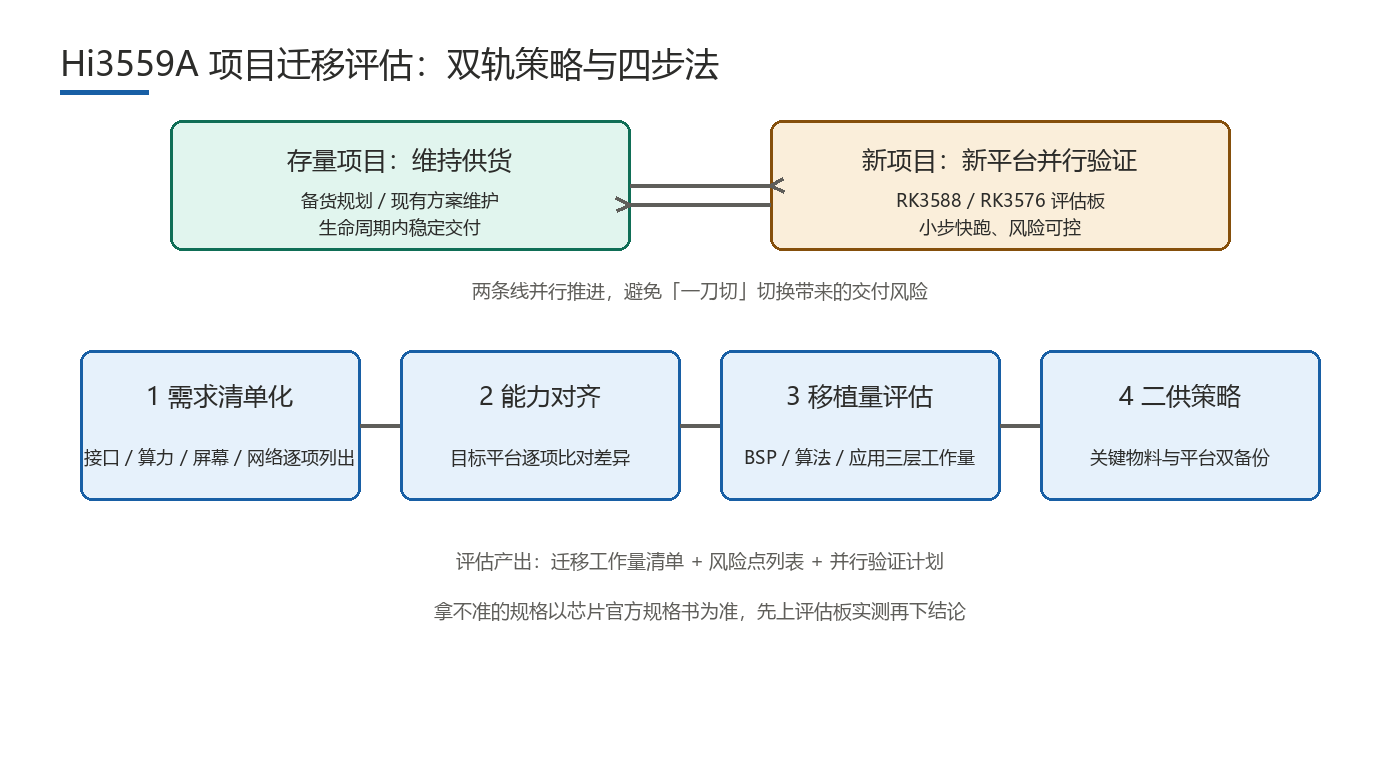
How Should the Dual-Track Strategy Be Scheduled?
The essence of dual-tracking is managing the time gap between two workstreams:
- Incumbent line: keep the current design and material plan unchanged; inventory key components, evaluate buffer stock, alternate parts, and last-time-buy windows so open orders keep shipping.
- Validation line: for projects in definition or pre-research, bring in one or two candidate platforms such as Rockchip RK3588 or RK3576 to surface BSP adaptation, RKNN model conversion, and ISP re-tuning issues at the prototype stage.
Scope the validation across three layers: basic BSP and peripheral bring-up; RKNN conversion of one or two business models to check quantization accuracy; and a first-pass ISP tuning with the original sensor. These map to the hardware, algorithm, and imaging risk lines — any one failing affects the schedule. Projects that require model requantization or full ISP re-tuning routinely take longer than expected, so start early; once supply pressure appears, the verification window is already too narrow.
What Does the Four-Step Assessment Look Like?
| Step | Key actions | Deliverable |
|---|---|---|
| Itemize requirements | List every platform dependency: channel count and interfaces, resolution and frame rate, codecs, ISP features, AI compute, OS and peripherals | Dependency checklist |
| Align capabilities | Map the checklist onto candidates with verifiable targets, e.g. 16-channel 1080p30 decode with 20% headroom | Capability alignment matrix |
| Estimate porting effort | Classify each algorithm module as convertible, minor rework, or rewrite; add BSP and driver effort | Effort and schedule estimate |
| Plan second source | Define primary-plus-backup platform mix, alternate component list, and a 2-3 year platform roadmap | Sourcing strategy document |
Two pitfalls recur: hidden dependencies missed during itemization (boot time, power-loss behavior) that surface at acceptance; and capability alignment done against chip parameters only, ignoring BSP maturity and vendor support. Document and review each step so conclusions are traceable.
Which Specifications Must Come from Official Datasheets?
Assessments attract secondhand numbers: forum-quoted decode limits, hearsay NPU figures, informal pinout claims. Before anything enters a selection document, confirm it against official sources — per-codec decode limits, MIPI lane counts and speeds, DDR configuration, power and thermal constraints. Hi3559A specifics should always be verified against the official Hisilicon datasheet, and RK3588 parameters cross-checked with Rockchip documentation and SoM vendor materials. Ambiguous specifications are a common root of late-stage rework.
FAQ
- Q1: Can Hi3559A still be used in new projects?Technically yes — it remains a mature imaging platform and shipped products run stably. For new or long-lifecycle projects, however, start validating a backup platform in parallel so supply changes do not compress your decision window.
- Q2: Doesn't dual-tracking split resources?Parallel validation only needs prototype-level investment to expose BSP, model conversion, and ISP risks early. Teams often start with a small validation share and adjust as progress dictates.
- Q3: How long does the assessment take?Requirement itemization and capability alignment typically take one to two weeks; algorithm porting estimation depends on model count, usually two to four weeks for a reliable schedule.
- Q4: When is staying on Hi3559A the better call?For shipped products near the end of orders with no new features, where algorithms and image tuning are deeply tied to the original platform, maintenance plus buffer stock usually beats migration.
Supply environment change is an industry-wide topic, not a verdict on any platform. Protect existing deliveries, validate early in parallel, and turn assessment into executable checklists — that converts uncertainty into a manageable platform roadmap.
Further reading: Migrating from Hisilicon to Rockchip: Workload Assessment and Implementation Path, Rockchip vs HiSilicon: Choosing a Platform for Security & Monitoring Products, Will Our SoM Be Discontinued? Supply Cycle, EOL Risk and Product Lifecycle Management (2026).
Shenzhen Hongyin Technology Co., Ltd. (HONGYIN TECH) provides embedded project customization on RK3588/RK3576/RK3568 platforms — free requirement review, engineer-direct communication and low-volume ordering. Send your requirement list and receive selection advice and quotes within 48 hours.
phone +86 13728726926 | email sales@hoyin-tech.com | website www.hoyin-tech.com | address: Room 301, Building A, Fanrong Science Park, Sanwei Community, Hangcheng Street, Bao'an District, Shenzhen, China.
Hongyin Tech provides full-stack SoM/SBC customization on Rockchip & HiSilicon platforms with Android/Linux. Engineers respond within 1 business day.
Get a Free Quote →