Vehicle Intelligent Terminal and Fleet Management Solution
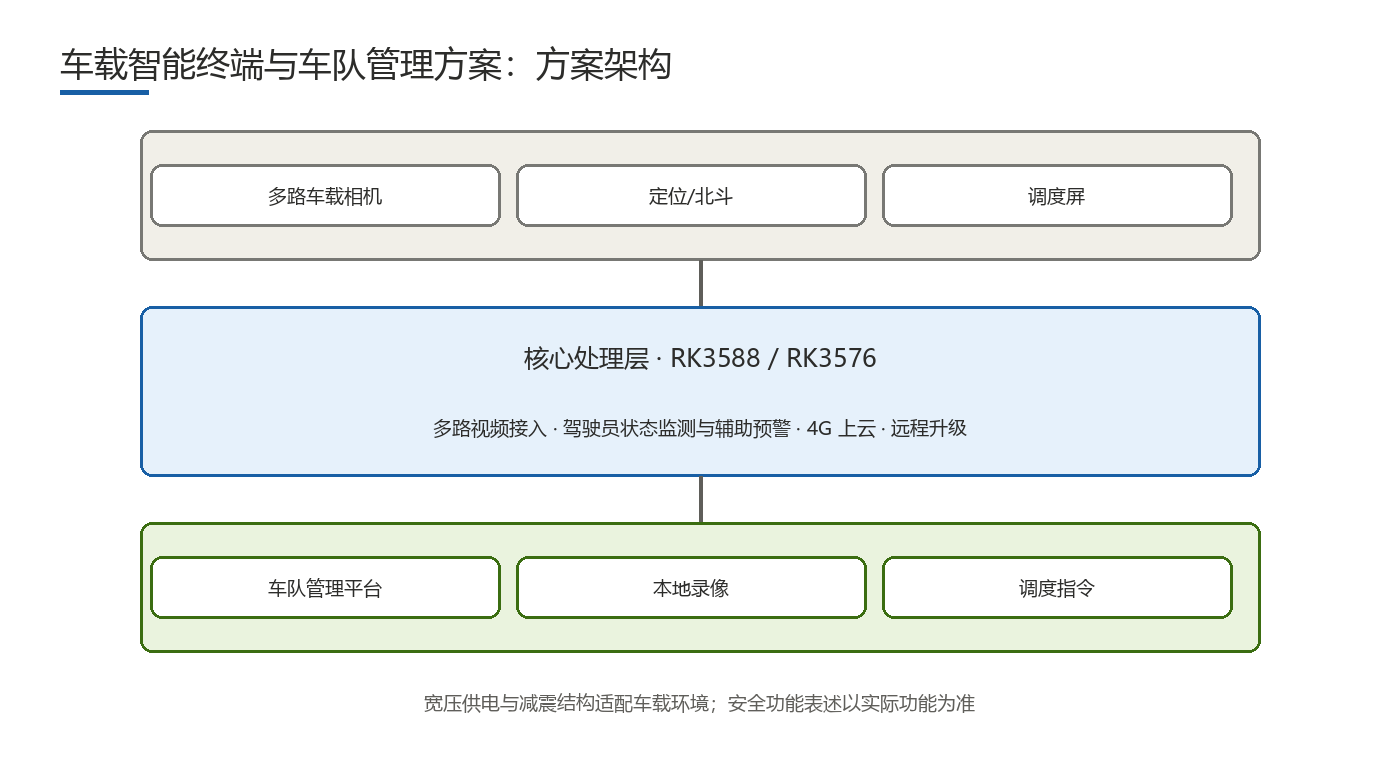
Logistics, construction and bus fleets commonly struggle with scattered vehicles, hard-to-supervise driving behavior and unclear accident liability. Based on RK3588/RK3576 core boards, this solution delivers multi-channel camera input, driver status monitoring with assistive alerts, wide-voltage power, BeiDou/4G positioning, dispatch display interaction and OTA updates, with full custom enclosure options per vehicle type. Hongyin Tech engineers work with you directly — receive selection advice within 48 hours.
Pain Points
- Vehicles operate across wide areas, making real-time position and task status hard to track
- Fatigued or distracted driving goes unnoticed, creating major safety risks
- Complex vehicle electrical environments with voltage swings and vibration cause frequent equipment failures
- Incomplete video and positioning data after incidents makes liability determination difficult
- Firmware is scattered across vehicles; upgrading each unit on-site is slow and costly
Recommended Hardware Configuration
| SoC platform | RK3588 (4×A76 + 4×A55) or RK3576, selected by channel count and compute needs |
|---|---|
| AI computing power | 6TOPS NPU for local inference of driver status monitoring and assistive alert algorithms |
| Video input | Multiple MIPI CSI/GMSL camera inputs covering forward, driver, cabin and side views |
| Positioning & network | BeiDou/GPS dual-mode positioning, 4G full-network support, optional Wi-Fi/Bluetooth |
| Display output | HDMI/LVDS for dispatch or aftermarket displays, with fast reverse-camera pop-up |
| Power & structure | 9–36V wide-voltage input with reverse-polarity and surge protection, vibration-resistant design |
Software Capabilities
- Driver status monitoring: in-cabin camera inference on the local NPU detects fatigue and distraction, triggering assistive alerts
- Multi-channel recording with evidence retention: loop recording with pre/post-event clip locking, combined with trajectory data for after-action review
- Real-time positioning and dispatch: BeiDou/4G reports position and vehicle status while the dispatch platform issues task commands
- OTA updates: remote batch upgrades of firmware and algorithm models across the whole fleet
- Wide-voltage power management: delayed shutdown after ignition-off and low-voltage protection to safeguard the vehicle battery
Deliverables & Services
- Free requirement review: clarifying vehicle type, camera channel count and dispatch integration needs, with configuration advice
- Hardware design: wide-voltage vehicle power, camera input and enclosure protection design
- BSP/driver/algorithm: system adaptation, camera drivers and driver-monitoring algorithm integration
- Prototype integration: on-vehicle testing, vibration and power condition verification, platform joint debugging
- Pilot and mass production: low-volume orders for fleet trials, with continuous supply for mass production
FAQ
Q:Should the vehicle terminal use RK3588 or RK3576?
It mainly depends on camera count and algorithm load: for up to 4 channels focused on positioning, recording and basic status monitoring, RK3576 offers better value; for 6+ channels, parallel algorithms or large-screen interaction on flagship vehicles, RK3588 is recommended. Share your vehicle type and feature list in the free requirement review and get a concrete configuration proposal within 48 hours.
Q:How are wide-voltage power and vibration resistance handled?
The power stage uses 9–36V wide-voltage input with reverse-polarity protection, surge suppression and low-voltage cutoff, plus delayed shutdown after ignition-off. The enclosure is designed for vehicle vibration with locking connectors. Detailed specifications are provided in the product manual after design review, and on-vehicle testing can be arranged for verification.
Q:Does driver status monitoring raise privacy concerns for drivers?
All image algorithms run locally on the terminal's NPU; only structured alerts (such as fatigue or distraction events with snapshots) are pushed to the platform, with no continuous video upload to the cloud. Alert thresholds and retention policies can be configured per fleet rules. We also recommend publishing the monitoring policy to drivers at deployment to balance safety and compliance.
Q:Can the terminal integrate with our existing fleet dispatch system?
Yes. The device provides standard interface protocols for position reporting, task dispatch and alert push, compatible with mainstream dispatch platforms; private protocols can be adapted during customization. Share your platform API documentation and our engineers will run joint debugging — integration is typically validated at the prototype stage.
Related Technical Articles
Share your scenario and requirements — free requirement review, selection advice within 48 hours.
Get a Free Quote →