Transmission Line Corridor Visual Monitoring Solution
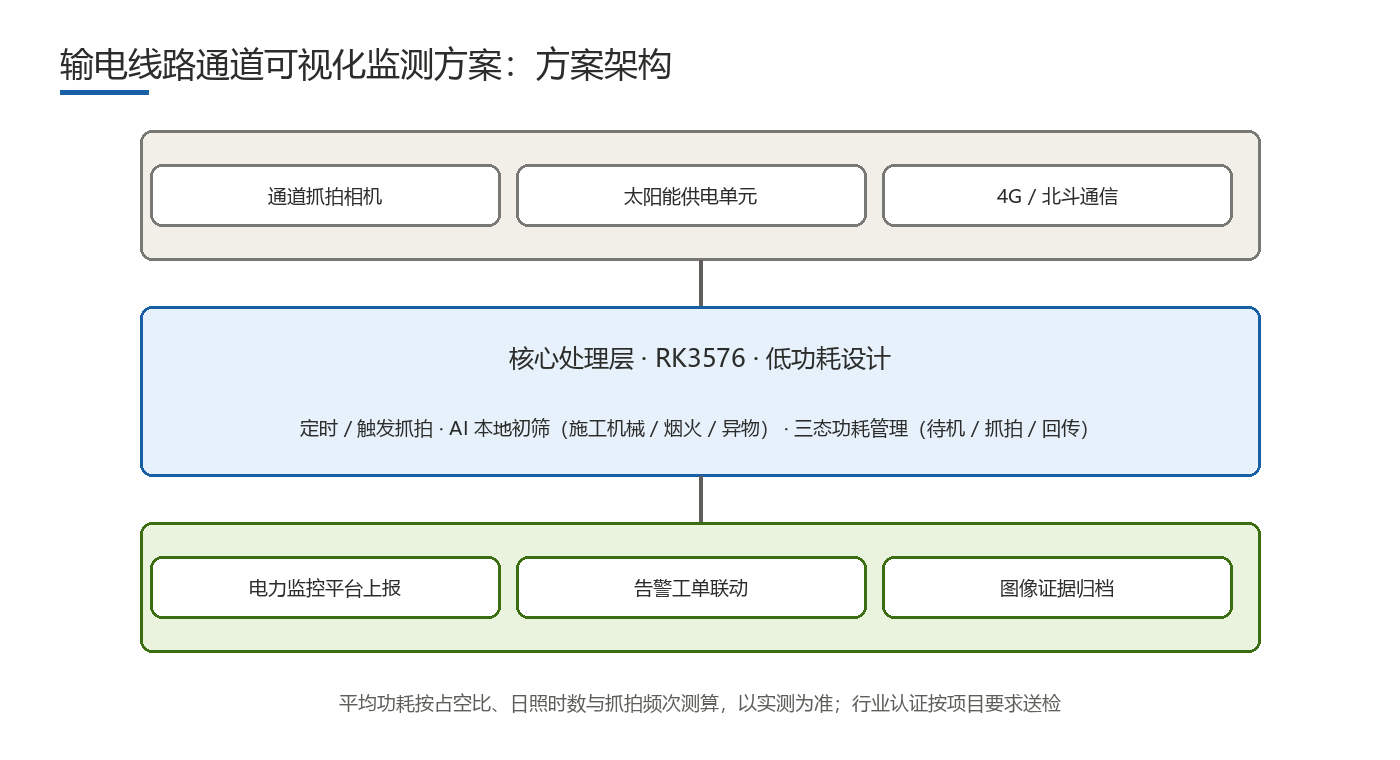
Visual monitoring of transmission corridors is best built on the RK3576 core board, where the core is spending limited power and data traffic only on frames worth sending back. The platform pairs a 4×A72 + 4×A53 CPU with a 6TOPS NPU, supports scheduled and sensor-triggered capture, pre-screens for construction machinery, fire and debris on-device, uploads only valid images and alarms over 4G or BeiDou to the grid platform, and runs on solar plus battery with a power budget split across standby, capture and backhaul states. Hongyin Tech provides a free requirement review and complete-device customization, with selection advice within 48 hours.
Pain Points
- Lines cross mountains and ridges where most towers lack mains power and fiber, making cabling unaffordable
- Excavation, tree growth and wildfire appear suddenly, and monthly foot patrols rarely catch them in time
- Limited solar input cannot support always-on cameras and 4G, so batteries drain repeatedly
- Uploading every image is expensive in data traffic, and most corridor frames carry no value
- Terminals sit in remote terrain, so troubleshooting a fault means climbing the tower at high cost and slow recovery
Recommended Hardware Configuration
| SoC platform | RK3576 (4×Cortex-A72 + 4×Cortex-A53); refer to the datasheet for details |
|---|---|
| AI computing power | 6TOPS NPU pre-screening machinery, fire and debris locally to cut useless uploads |
| Memory & storage | Optional LPDDR4/LPDDR5 with eMMC, keeping snapshots in a local circular buffer |
| Video input | MIPI CSI camera input with optional visible-light or thermal, supporting scheduled and triggered capture |
| Network & interfaces | 4G cellular with optional BeiDou positioning and short messaging; RS485 for weather and tilt sensors |
| Enclosure & protection | Clamp or pan-tilt integrated housing with IP protection and lightning grounding; separate solar panel and battery compartment |
Software Capabilities
- Capture policy: scheduled snapshots plus triggers from intrusion and tilt sensors, avoiding all-day continuous recording
- On-device pre-screening: NPU checks frames for machinery, fire and debris, reporting only hits and alarms
- Power management: separates standby, capture and backhaul states, scheduling camera, NPU and 4G power by duty cycle
- Backhaul and retry: picks 4G or BeiDou by signal quality, queues failed jobs and resumes broken transfers
- Platform integration: reports images, alarms and device health per grid platform specifications, with remote configuration and firmware upgrade
Deliverables & Services
- Requirement review (free): map tower sites, sunshine conditions, capture frequency and platform specs, and deliver selection and power-budget advice
- Hardware design: core board selection, carrier board customization, power and battery management, protection and lightning grounding structure
- BSP/drivers/algorithms: low-power sleep and wakeup, camera and sensor drivers, pre-screening model deployment and false-positive tuning
- Prototype integration: build prototypes, test field power and capture, log current curves and commission the platform link
- Low-volume and mass-production support: low MOQ, power-consistency control, firmware upgrades and long-term supply
FAQ
Q:Should a corridor monitoring terminal use RK3576 or RK3588?
Corridor monitoring is mainly scheduled capture with lightweight AI pre-screening, so RK3576 fits better: 4×A72 + 4×A53 with a 6TOPS NPU, at a power and cost level suited to solar-powered terminals. Evaluate RK3588 only when multi-channel real-time analysis or higher encoding specs are needed. Interface counts and codec channels follow the datasheet; share site details and capture frequency for advice within 48 hours.
Q:How is the power budget calculated, and how long can the terminal run?
Power is accounted separately for standby, capture and backhaul: standby keeps only RTC and watchdog alive, capture briefly wakes camera and NPU, and backhaul draws the highest peak current from the 4G module. Average consumption follows the duty cycle of these three states and must be calculated with local sunshine hours and daily capture counts — quoting runtime days without that context is meaningless. We budget from measured current curves and verify on prototypes.
Q:What determines the cost of a corridor visual monitoring terminal?
Cost is set by terminal count, camera and pan-tilt configuration, solar panel and battery capacity, AI pre-screening algorithms and platform integration effort. Battery capacity is often underestimated, yet the number of consecutive overcast days drives it directly, and tuning algorithms on local samples adds work. Start with a free requirement review to fix sites, sunshine and capture frequency, then estimate line by line.
Q:How does the terminal connect to the grid platform, and how are certifications handled?
The terminal integrates with the customer's existing grid monitoring system and industry specifications, supporting common protocols and encrypted access as defined in the project technical agreement. Power-industry certifications are submitted as each project requires; whether radio type approval, EMC and ingress protection testing are needed depends on the tender documents. Provide the technical specification during the requirement review and we will confirm feasibility and the submission list.
Related Technical Articles
Share your scenario and requirements — free requirement review, selection advice within 48 hours.
Get a Free Quote →