Smart Parking Lot Solution
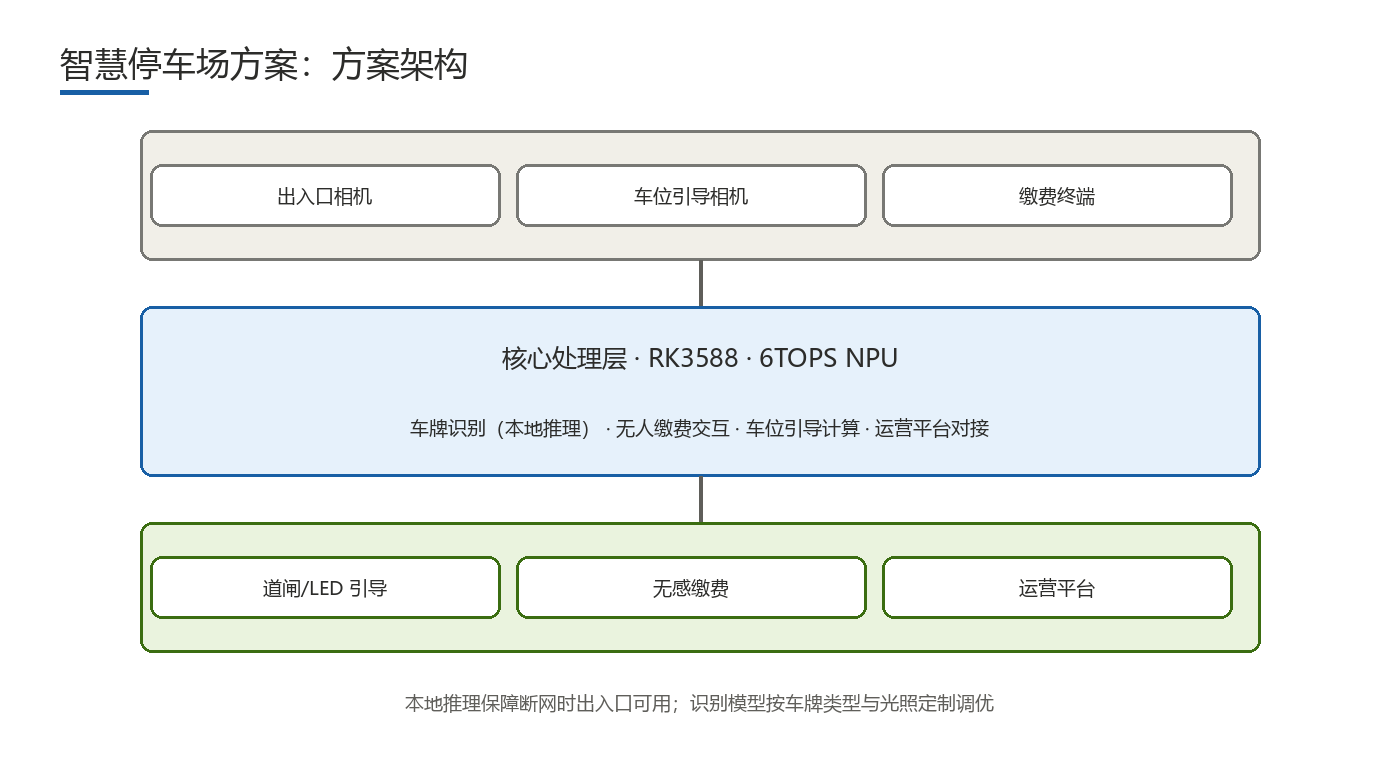
Parking operators' core needs are fewer staff, faster vehicle flow and monetizable data. Based on the RK3588 core board (6TOPS NPU), license plate recognition runs fully on-device, unifying entry/exit recognition, unattended payment, space guidance and barrier control in one system, with standard interfaces to parking operation platforms. Hongyin Tech supports custom builds per project — free requirement review, with selection advice within 48 hours.
Pain Points
- Manual card issuing and payment at entrances are slow, causing long queues at peak hours
- Cloud-based recognition stalls vehicle flow whenever the network fluctuates
- Drivers struggle to find spaces, keeping utilization and turnover rates low
- Cash and QR-code payment steps consume labor, while fee evasion is hard to control
- Data stays siloed per lot, leaving operators without unified management or decision support
Recommended Hardware Configuration
| SoC platform | RK3588 (4×Cortex-A76 + 4×Cortex-A55) running recognition, payment and display tasks concurrently |
|---|---|
| AI computing power | 6TOPS NPU for on-device license plate recognition and vehicle detection, independent of external networks |
| Camera input | MIPI CSI HD camera input, reusable across entry/exit and in-lot guidance positions |
| Display output | HDMI/LVDS dual display output for entry/exit LED screens and payment kiosk touchscreens |
| Peripheral control | RS485/GPIO control for barriers, ground loops, voice units and fill lights |
| Network & structure | Gigabit Ethernet/4G dual links with outdoor-rated enclosure for entry/exit environments |
Software Capabilities
- License plate recognition: on-device NPU inference for plates and vehicle attributes, tunable for night and backlight scenes
- Unattended payment: QR-code and cardless payment options with voice and on-screen self-service guidance
- Space guidance: integrates space detection data to direct drivers to available spots on in-lot displays
- Barrier linkage: recognition results trigger barrier control and passage prompts, with whitelists and anomaly interception
- Platform integration: standard reporting interfaces for entry/exit data, orders and device status to connect with operation platforms
Deliverables & Services
- Free requirement review: defining entry/exit counts, lane types and platform integration requirements
- Hardware design: recognition all-in-one unit, payment kiosk carrier board and outdoor enclosure design
- BSP/driver/algorithm: OS customization, peripheral drivers and recognition model deployment and tuning
- Prototype integration: on-site recognition rate testing, barrier linkage and platform joint debugging
- Pilot and mass production: phased deployment supply with O&M and firmware upgrade support
FAQ
Q:What are the advantages of local NPU-based plate recognition over cloud recognition?
Local inference does not depend on external networks, so vehicle flow stays stable regardless of connectivity. It also eliminates continuous video upload bandwidth and per-recognition cloud fees, lowering long-term operating costs. The RK3588's 6TOPS NPU easily handles peak concurrent recognition at entry/exit lanes, and models can be tuned for scenes like night and backlight.
Q:How is the investment for an unattended parking solution structured?
Costs mainly comprise recognition/payment terminal hardware, platform integration development, installation and ongoing maintenance. Compared with staffed operation, unattended setups typically recover their investment within a reasonable period through labor savings. Exact pricing depends on the number of lanes and feature set — we provide an itemized quote after the free requirement review rather than quoting blindly here.
Q:Can the solution integrate with the parking platform we already use?
Yes. The device provides standard interfaces for plate data, entry/exit records, orders and device status, compatible with mainstream parking platforms; private protocols can be adapted per API docs during customization. Share the integration documentation at the requirement review stage, and our engineers will validate it on the prototype.
Q:How is plate recognition accuracy maintained at night and in rain or fog?
On the hardware side we pair fill lights with suitable camera modules; on the software side we tune models and ISP parameters for low light, rain, fog and dirty plates. Recognition is field-tested on the actual lanes at the prototype stage and deployed at scale only after meeting targets. Accuracy figures are based on field test reports — share your lane environment for an assessment.
Related Technical Articles
Share your scenario and requirements — free requirement review, selection advice within 48 hours.
Get a Free Quote →