Smart Agriculture Monitoring Solution
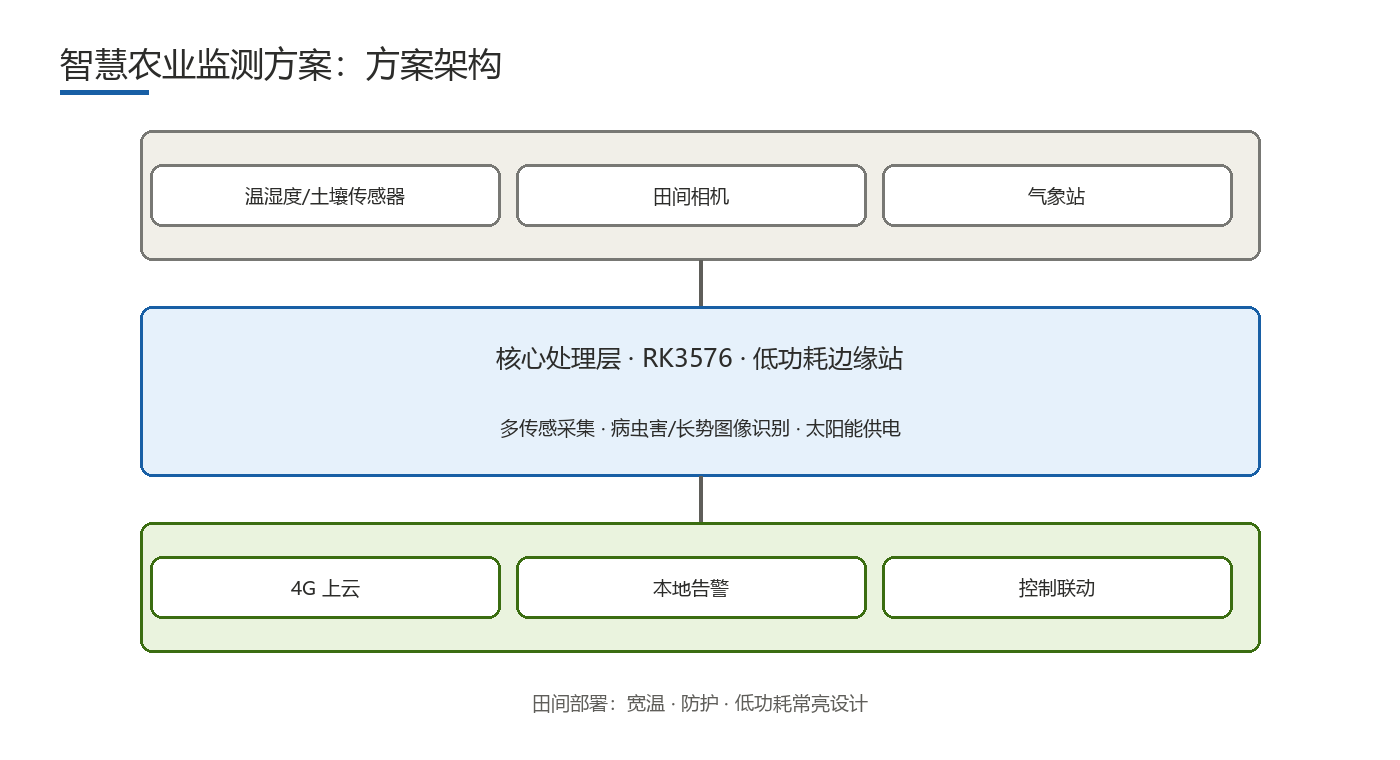
Field and greenhouse sites often lack stable power and network access, yet require continuous environmental monitoring and on-site crop assessment. Built on the RK3576, this solution delivers a low-power monitoring station with multi-sensor acquisition, on-device image recognition for pests and crop conditions, solar power support, and 4G cloud connectivity. Hongyin Tech provides hardware design, BSP and algorithm integration through to pilot units. Submit your requirements for a free review and selection advice within 48 hours.
Pain Points
- Field sites lack grid power; stations must run long-term on solar with ultra-low power consumption
- Unreliable connectivity in remote areas requires edge caching and resumable data upload
- Manual crop and pest inspection is inefficient and cannot scale across large planting areas
- Outdoor conditions such as wide temperature swings, humidity and lightning demand industrial-grade hardware
- Large numbers of dispersed stations need unified remote O&M and batch firmware updates
Recommended Hardware Configuration
| SoC platform | RK3576 (4x Cortex-A72 + 4x Cortex-A53, balancing performance and power efficiency) |
|---|---|
| AI compute | 6TOPS NPU for on-device pest and crop-condition inference |
| Memory & storage | LPDDR4/4x with eMMC local caching for resumable upload |
| Sensor I/O | Multiple RS485/RS232 channels for soil, weather and light sensors |
| Camera input | MIPI CSI camera for crop imaging and inspection photos |
| Network & power | 4G (multi-band) + Ethernet, with solar power and battery management support |
Software Capabilities
- Multi-source acquisition: supports mainstream agricultural sensor protocols such as Modbus, with scheduled sampling and local storage
- Edge AI inference: RKNN-deployed pest and crop detection models run on-site, uploading structured results only
- Low-power scheduling: timed wake-up and on-demand camera/communication to extend solar battery life
- Cloud connectivity: dual-channel 4G/Ethernet upload with local caching and automatic resync after outages
- Remote O&M: OTA firmware updates, device health monitoring and batch configuration
Deliverables & Services
- Free requirements review: site scale, sensor list and cloud architecture, with selection advice within 48 hours
- Hardware design: SoM selection, peripheral circuits, solar power system and weatherproof enclosure design
- BSP/drivers/algorithms: OS tailoring, sensor and camera driver integration, model deployment and optimization
- Pilot integration: on-site installation, cloud platform integration and data-link validation
- Volume support: low-volume ordering, supply planning and long-term lifecycle availability
FAQ
Q:How long can a station run without grid power?
The design uses solar panels with lithium battery backup, and the RK3576 platform supports low-power scheduling with on-demand camera and communication modules. Actual runtime depends on sunlight conditions, sampling frequency and photo counts. We provide a power budget and configuration advice during the free requirements review.
Q:Do we need to supply our own pest detection model?
Both options work. If you have a trained model, we handle RKNN conversion, quantization and NPU deployment. If not, we can start with an open-source model for scenario validation and iterate with you. During review, we assess your detection targets and accuracy needs and propose a feasible compute and model plan within 48 hours.
Q:How do you prevent data loss in areas with poor signal?
All sampled data and images are cached in local eMMC and automatically re-uploaded after the connection recovers, with dual 4G and Ethernet channels for redundancy. For extreme weak-signal sites, we can evaluate external antennas or adjusted upload cycles during the review phase.
Q:What is the process from requirements review to prototype?
The workflow is: submit requirements, free review and selection advice within 48 hours, hardware and enclosure design confirmation, BSP and algorithm integration, then pilot validation. If your needs align with our existing SoM and reference design, the timeline shortens considerably. Concrete milestones are confirmed with the proposal after review.
Related Technical Articles
Share your scenario and requirements — free requirement review, selection advice within 48 hours.
Get a Free Quote →