Pump Station and Water Plant Unattended Terminal Solution
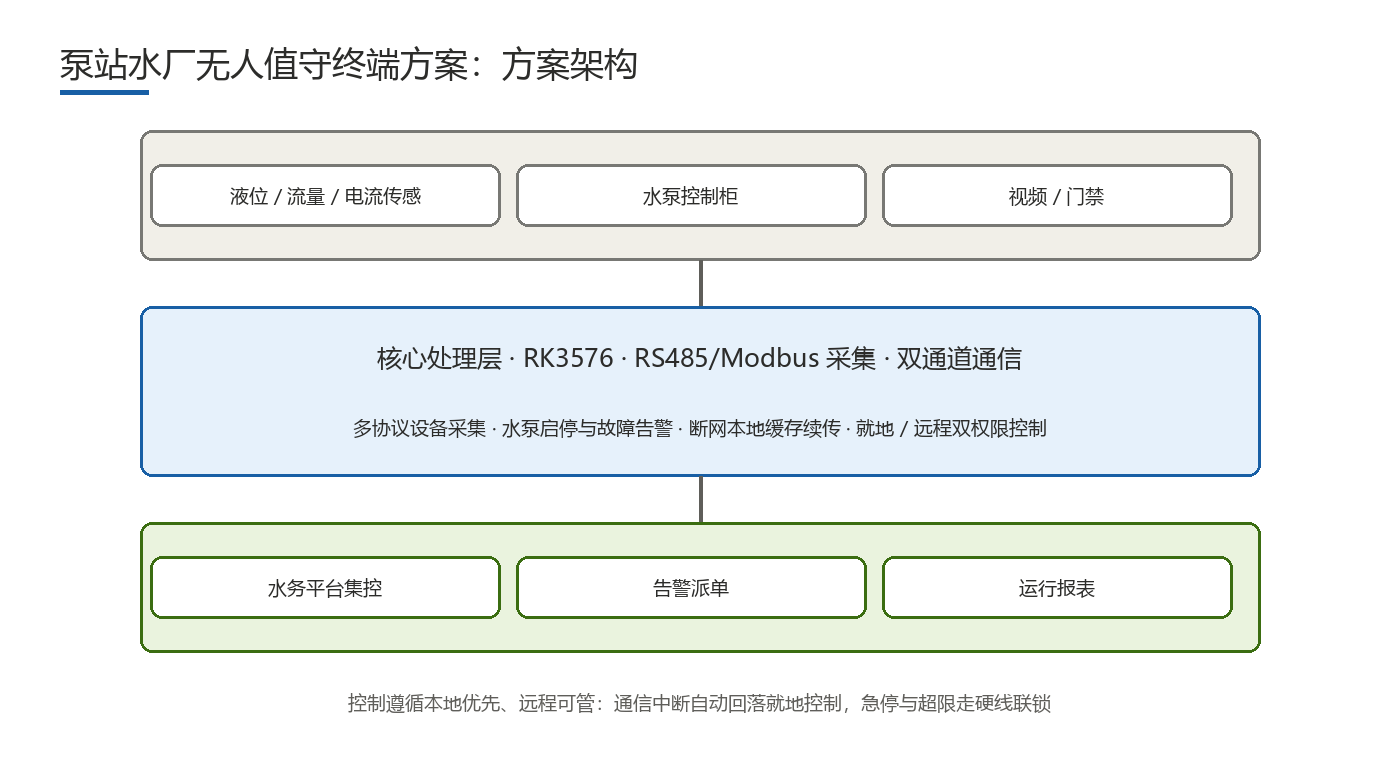
Unattended pump stations can run on an RK3576 edge terminal: it polls PLCs, meters and soft starters over RS485/Modbus, and reports to the water platform over 4G and wired links. The core is a local loop — level, current or temperature breaches are judged on site and linked to pump start/stop, buffering data during outages for later upload. A panel selector plus software state confirms control authority, local-first with manageable remote access, while emergency stop, dry-run and over-temperature protection stay hard-wired. Hongyin Tech offers a free review and complete-terminal customization, with selection advice within 48 hours.
Pain Points
- Stations are scattered and remote, so staffing each site keeps labor and travel costs high
- PLCs vary by brand and generation, with inconsistent RS485/Modbus point definitions
- During outages or platform maintenance, data stays local and cannot be backfilled afterwards
- Pump faults and level overruns are found manually, so night-time response lags noticeably
- Humid, dusty pump houses with lightning and voltage surges raise the failure rate of ordinary industrial devices
Recommended Hardware Configuration
| SoC platform | RK3576 (4×Cortex-A72 + 4×Cortex-A53) running Linux for always-on duty; refer to the datasheet for details |
|---|---|
| AI computing power | 6TOPS NPU for lightweight local analysis of level trends and current waveforms, used as advisory hints only |
| Memory & storage | Optional LPDDR4/LPDDR5 with eMMC as primary storage plus expansion, retaining months of acquisition and alarm records locally |
| Video input | MIPI CSI / USB cameras and RTSP network cameras for viewing pump rooms and wet wells |
| Network & interfaces | Dual Ethernet plus 4G cellular for mutual backup, RS485/RS232, DI/DO, 4–20mA and relay outputs with Modbus RTU/TCP |
| Enclosure & protection | Metal enclosure with moisture-proof coating and independent grounding, wide-temperature design plus surge and lightning protection; ingress rating set by project requirements |
Software Capabilities
- Protocol acquisition: polls PLCs, meters and soft starters from different vendors via a configurable point table, running Modbus RTU/TCP and custom protocols in parallel
- Linkage control: starts and stops pumps and drives valve DO outputs against level, flow, current and temperature thresholds, with delay confirmation and equipment interlocking
- Control authority: remote commands are accepted only after both the panel selector and software state agree; a lost link falls back to local logic, local-first by design
- Store-and-forward: time-stamped readings and alarms are written to storage and uploaded in order once the network recovers, keeping platform curves continuous
- Platform integration: reports to water utility platforms over MQTT/HTTP/Modbus TCP, with point mapping and status acknowledgement per project protocol documents
Deliverables & Services
- Requirement review (free): clarify site count, acquisition points, control loops and platform interfaces, and deliver selection and retrofit scope advice
- Hardware design: core board selection, carrier board customization, isolated IO, surge and moisture protection design
- BSP/drivers/protocols: system trimming, serial and IO driver adaptation, Modbus point tables and linkage logic development
- Prototype integration: build the prototype, run on-site pump station trials, and integrate with existing PLCs, SCADA and the water platform
- Low-volume and mass-production support: low MOQ, batch consistency and remote firmware upgrade maintenance
FAQ
Q:Should a pump station terminal use RK3576 or RK3588?
For stations dominated by acquisition, protocol conversion and local linkage, RK3576 (4×A72 + 4×A53, 6TOPS NPU) is sufficient, and its power and cost profile suits one-terminal-per-site deployment. If a single station must take multiple video channels with real-time analysis, RK3588 can be evaluated; refer to the datasheet for interface and codec details. Share your point table and camera count for selection advice within 48 hours.
Q:What makes up the cost of an unattended pump station terminal?
Cost comes down to three parts: the number of acquisition points and control loops drives IO count and isolation design; camera channels and retention period drive memory and storage; the number of platforms to integrate drives protocol development effort. A standard core board plus carrier board changes little, while a full custom enclosure and multi-platform integration add investment. Start with a free requirement review that fixes the point table, camera count and interface documents before estimating — no inflated pricing.
Q:How are remote and local control switched, and how is safety interlocking handled?
Control authority uses two-level confirmation: a panel selector provides the local/remote state, software reads it back, and remote commands are allowed only when both agree. Local-first is the default — if the link drops or the platform goes offline, the terminal falls back to local logic, and remote access can only change setpoints, never bypass on-site operation. Emergency stop, dry-run, over-temperature and over-pressure protection remain on hard-wired interlocks independent of network and software, while remote start/stop adds delay confirmation and equipment interlocking to prevent false operation.
Q:Legacy pump stations use mixed PLC brands — how do they connect to an existing water platform?
Downstream, the terminal polls PLCs and meters of different brands over Modbus RTU/TCP with a configurable point table, so existing controllers need not be replaced. Upstream it supports MQTT/HTTP/Modbus TCP, mapping points and backfilling data per the water platform's interface documents. If the existing SCADA uses other protocols, a protocol gateway can convert them; specifics follow the project's technical documents, and certification is submitted as the project requires.
Related Technical Articles
Share your scenario and requirements — free requirement review, selection advice within 48 hours.
Get a Free Quote →