All-in-One Live Streaming Switcher Solution
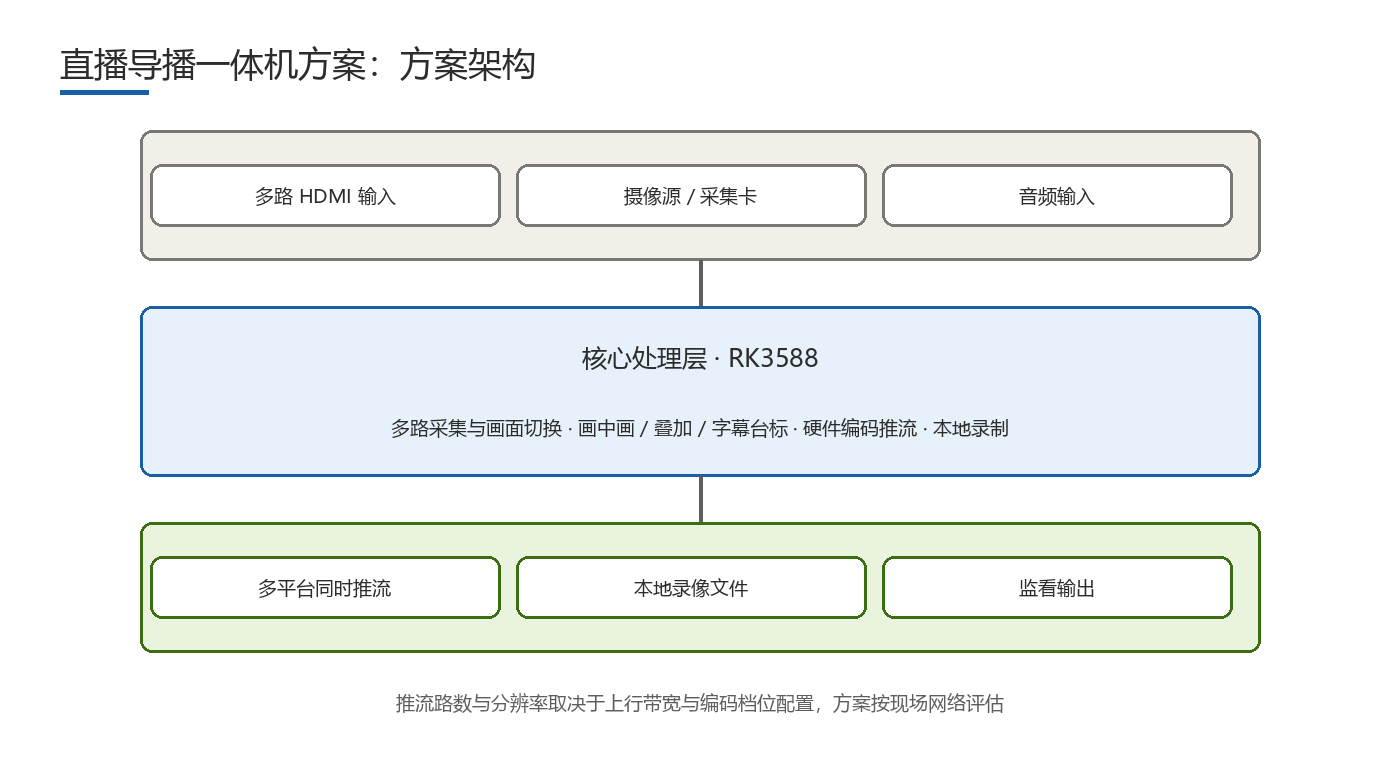
Livestreamed conferences, e-commerce sessions and mid-size sports events often need several camera feeds switched live with picture-in-picture, subtitles and logos, then pushed to multiple platforms while being archived locally. Built on the RK3588 core board (4×A76 + 4×A55, 6TOPS NPU), this solution covers multi-channel HDMI capture, program switching and overlays, concurrent multi-platform streaming and local recording, letting a single board replace a stack of switchers and encoders. Get selection advice within 48 hours.
Pain Points
- Traditional production stacks switchers and encoders, meaning more devices, tangled cabling and higher cost
- HDMI inputs differ in resolution and frame rate, causing black frames or desync on switching
- Streaming platforms require different parameters, and one device pushing several feeds at once easily drops frames
- Picture-in-picture, subtitle and logo overlays depend on professional software, raising on-site operating difficulty
- Live streaming plus local archiving puts heavy stress on storage write throughput and concurrency
Recommended Hardware Configuration
| SoC platform | RK3588 core board (4×Cortex-A76 + 4×Cortex-A55) running capture, compositing and streaming in parallel |
|---|---|
| Memory & storage | LPDDR4/LPDDR5 and eMMC sized by input channels, with SSD expansion for local recording |
| Video input | Multi-channel HDMI capture, with HDMI-to-MIPI/CSI conversion designed per channel count and board layout |
| Display output | HDMI output for program feed and local multiview monitoring, with configurable preview layouts |
| Network & streaming | Gigabit Ethernet and dual-band Wi-Fi supporting concurrent multi-platform streaming with wired and wireless backup |
| Structure & thermal | All-in-one enclosure customized to the product form, with metal heat spreading and airflow design for long streaming sessions |
Software Capabilities
- Multi-input capture: multi-channel HDMI capture with a unified time base and resolution adaptation to reduce switching glitches
- Switching and overlays: preview and program views with on-site adjustable picture-in-picture, subtitles, logos and transitions
- Concurrent multi-platform streaming: one program to several platforms at once, with per-stream bitrate and encoding settings
- Local recording and playback: record the program output or a single input, with simultaneous stream-and-record and later playback
- Operation and remote management: local touchscreen control, web remote control and streaming health monitoring with alerts
Deliverables & Services
- Free requirement review: confirming input channels, required overlay features, target platforms and recording needs
- Hardware design: core board selection, carrier board for HDMI capture and display output, plus structure and thermal design
- BSP/driver/algorithm: OS customization, capture and display drivers, compositing and streaming feature development
- Prototype integration: testing multi-platform concurrency, video latency, recording stability and temperature rise in real streaming conditions
- Pilot and mass production: low-volume orders, production test plans, firmware upgrade and long-term supply support
FAQ
Q:For an all-in-one switcher, how many HDMI inputs make sense?
Start from the use case: conference and classroom streaming typically use three to four cameras, while e-commerce and small sports events often need four to six. More channels consume capture interfaces, memory bandwidth and encoding resources at once, so decide from the actual camera count and whether secondary picture-in-picture feeds are needed. Send us your camera count and streaming platforms for a free review and configuration advice within 48 hours.
Q:Will pushing to several platforms at once cause dropped frames?
Stability depends on total encoding channels and total bitrate rather than the number of platforms. The solution offloads main encoding to hardware, configures bitrate and resolution per stream independently, and can lower secondary stream quality when needed to keep the main feed smooth. Actual concurrency should be confirmed by testing with your resolution and bitrate, and long-duration multi-platform stress tests can be run during the prototype stage.
Q:Can the solution connect to the streaming platforms and proprietary protocols we use?
It supports mainstream streaming protocols such as RTMP and RTSP, so it connects to common live platforms directly. If your platform uses a proprietary protocol or custom authentication flow, sharing the interface documentation is enough for us to assess the adaptation approach and effort, and we can support integration testing when needed.
Q:How are cooling and stability ensured during long live sessions?
The enclosure uses a metal body and a custom airflow path for heat dissipation, and the layout keeps heat from the encoding chip and power section from stacking. On the software side, temperature is monitored with protection strategies such as automatic bitrate or secondary-resolution reduction. The practical continuous runtime and ambient temperature depend on the final enclosure and measured results, so long-duration streaming validation is recommended at the prototype stage.
Related Technical Articles
Share your scenario and requirements — free requirement review, selection advice within 48 hours.
Get a Free Quote →