Online Environmental Monitoring Station Solution
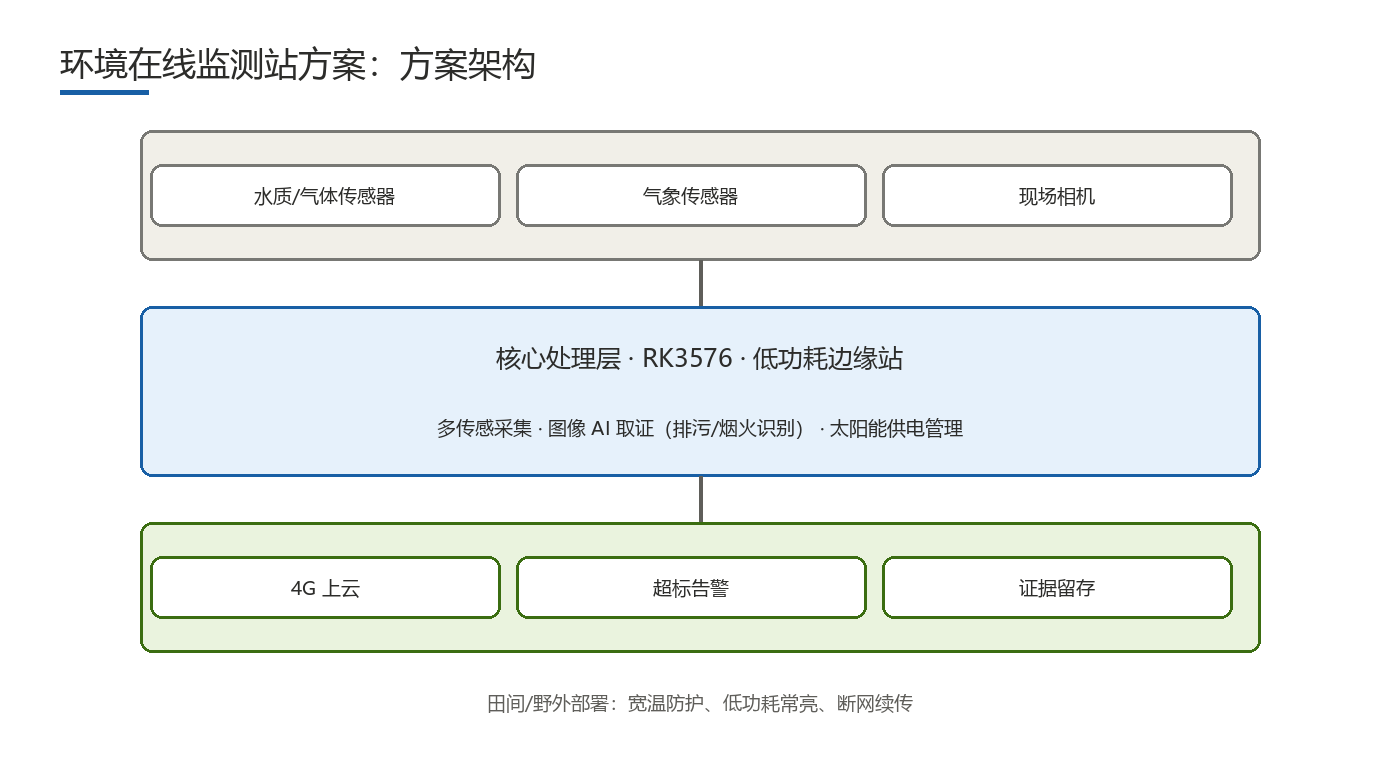
River outfalls, straw burning spots and construction sites are often remote and unattended, requiring both continuous sensor acquisition and visual evidence. Built on the RK3576 core board (4×A72 + 4×A53, 6TOPS NPU), this solution integrates multi-sensor acquisition, AI image recognition and a solar-powered low-power design, pushing structured data and alerts to the cloud over 4G. Hongyin Tech offers a free requirement review and full custom delivery — send us your scenario and receive selection advice within 48 hours.
Pain Points
- Monitoring sites are remote, with no grid power or wired network, driving up deployment and O&M costs
- Water, gas and weather sensors use different protocols, making gateway integration labor-intensive
- Sensor values alone cannot reconstruct the scene; pollution or burning behavior lacks image evidence
- Conventional industrial PCs draw too much power for solar systems, causing frequent winter outages
- Data stays siloed on-site with no unified cloud reporting or platform integration capability
Recommended Hardware Configuration
| SoC platform | RK3576 (4×Cortex-A72 + 4×Cortex-A53), balancing performance and low power |
|---|---|
| AI computing power | 6TOPS NPU supporting on-device image classification and object recognition |
| Memory & storage | Optional LPDDR4/LPDDR5 with eMMC storage, local buffering and resumable upload |
| Sensor interfaces | Multiple RS485/RS232 ports (Modbus), analog and digital inputs for water/gas/weather sensors |
| Camera input | MIPI CSI camera input for scene image evidence at outfalls and fire spots |
| Network & power | 4G cloud connectivity with solar + lithium battery power and low-power sleep strategy |
Software Capabilities
- Multi-protocol acquisition: built-in Modbus RTU and common protocol parsing for quick integration of mainstream water, gas and weather sensors
- Edge AI recognition: NPU runs image models locally to detect and capture effluent discharge, smoke and burning targets on-site
- Store-and-forward: data and images are buffered locally during 4G outages and auto-uploaded once the network recovers
- Low-power management: scheduled wake-up and on-demand peripherals to extend solar system endurance
- Cloud integration: structured data reporting over MQTT/HTTP with protocol documentation and joint debugging support
Deliverables & Services
- Free requirement review: defining monitoring factors, sensor list and deployment environment, with selection advice
- Hardware design: core board selection, carrier board customization, solar power and enclosure design
- BSP/driver/algorithm: OS tailoring, sensor driver adaptation and edge AI model deployment
- Prototype integration: prototype build, field testing and cloud platform joint debugging
- Pilot and mass production: low-volume orders supported, with continuous supply and firmware maintenance
FAQ
Q:Why choose RK3576 instead of a higher-performance SoC for a monitoring station?
RK3576 combines a 4×A72 + 4×A53 architecture with a 6TOPS NPU, enough for image recognition and multi-protocol acquisition while keeping power draw low — ideal for solar-powered unattended stations. It saves energy versus higher-performance platforms and offers far more headroom than MCU solutions. Actual power figures depend on the final build; submit your requirements for free selection advice.
Q:How does a solar-powered station stay online through winter and cloudy days?
Three measures: a low-power platform with sleep/wake scheduling; battery and panel capacity calculated from local solar irradiance data instead of rules of thumb; and local buffering with resumable upload so short outages lose no data. The exact configuration depends on each site — we provide recommendations during the free requirement review.
Q:Can the solution integrate with our existing environmental monitoring cloud platform?
Yes. The device supports common reporting protocols such as MQTT and HTTP, and we provide full protocol documentation plus engineer-assisted integration. Custom private protocols can also be developed during the customization phase. Share your platform API docs at the requirement review stage and we will reply with feasibility within 48 hours.
Q:What about the accuracy and cost of on-site AI image recognition?
Recognition models run locally on the NPU and are trained specifically for fixed targets such as effluent discharge, smoke and open burning, going live only after field validation. Compared with streaming all video to the cloud, the edge approach greatly reduces 4G data and cloud compute costs. Accuracy depends on lighting and camera placement — validate with a prototype on-site before scaling up.
Related Technical Articles
Share your scenario and requirements — free requirement review, selection advice within 48 hours.
Get a Free Quote →