Energy Storage & Power Monitoring Terminal Solution
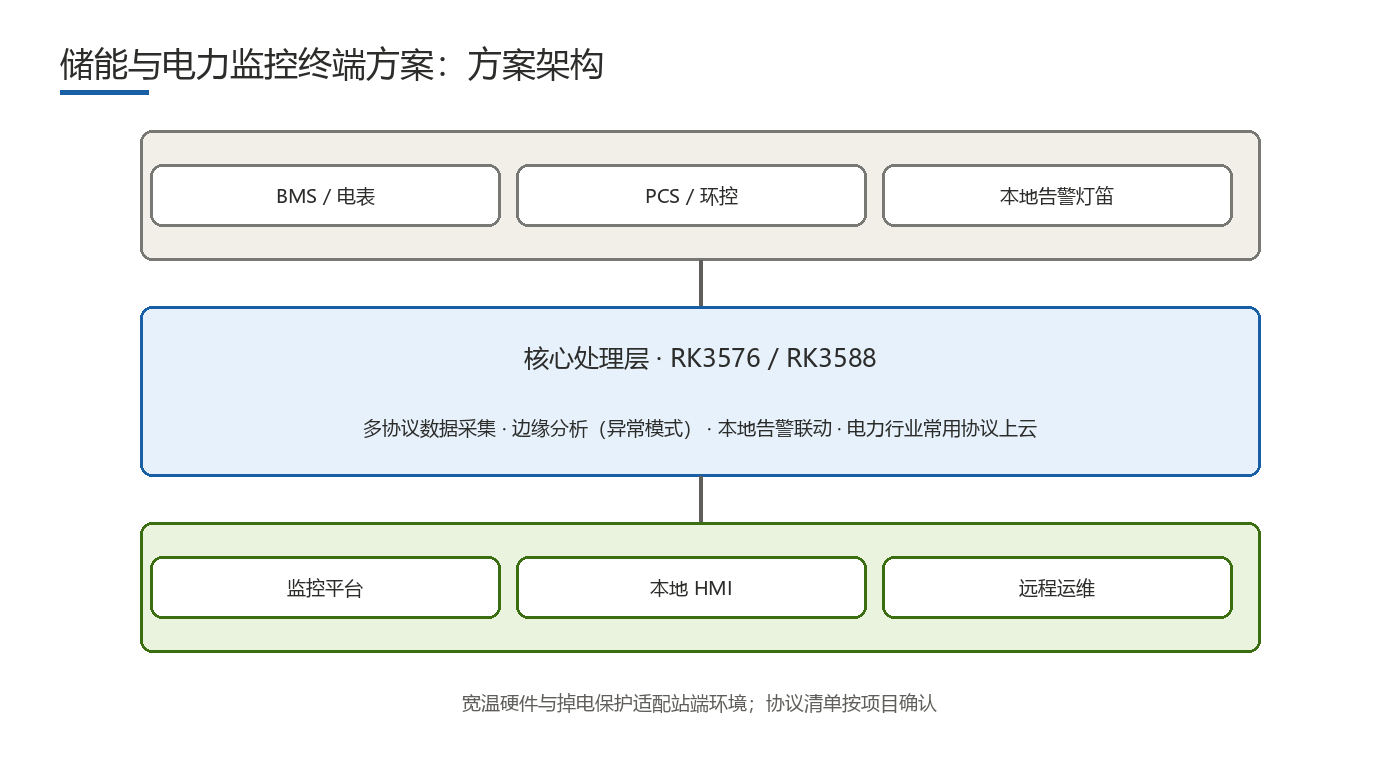
For C&I energy storage, distributed PV and substation modernization, this solution builds monitoring terminals and edge gateways on RK3576/RK3588: it acquires data from BMS units, meters and environmental sensors, triggers local alarm linkage with millisecond response, runs edge analytics to flag abnormal usage patterns, and uploads data using protocols common in the power industry. Remote O&M covers fleets of sites. Receive platform recommendations within 48 hours, with free requirement reviews and low-volume MOQ support.
Pain Points
- Manual meter reading and patrols mean delayed alarms — faults are often found only after losses occur
- Cloud-only alarm logic leaves storage sites blind during network outages, raising safety risks
- BMS, meters and inverters each speak different protocols, dragging out integration and platform onboarding
- Harsh sites — hot substations with strong EMI — push commercial-grade gateways to frequent failures and short lifespans
- Numerous scattered sites make on-site firmware upgrades and parameter tuning unaffordable in O&M labor
Recommended Hardware Configuration
| SoC platform | RK3576 as the main platform (4×Cortex-A72 + 4×Cortex-A53, 6TOPS NPU), with RK3588 optional for heavy edge analytics |
|---|---|
| AI compute | 6TOPS NPU for edge analytics such as abnormal usage pattern detection and thermal image analysis |
| Memory & storage | LPDDR and eMMC to buffer data during network outages and resume upload once reconnected |
| Acquisition I/O | Multiple RS485/CAN/RS232 ports for BMS, meters and inverters, with DI/DO for alarm linkage control |
| Networking & cloud | Dual Ethernet / 4G / Wi-Fi options with cloud connectivity over protocols common in the power industry and encrypted transmission |
| Enclosure & reliability | Fanless wide-temperature design for hot, EMI-heavy substation environments, DIN-rail or wall mounting (detailed specs per the product datasheet) |
Software Capabilities
- Multi-protocol acquisition: interoperates with BMS, meters and inverters via protocols common in the power industry, with data normalization
- Local alarm linkage: threshold breaches and communication faults trigger local logic and relay actions even when offline
- Edge analytics: NPU-based abnormal usage pattern detection and data-quality checks, reducing cloud compute costs
- Cloud connectivity: encrypted reporting per power-industry protocol and platform onboarding standards, with resumable transfer
- Remote O&M: fleet-wide remote configuration, OTA firmware upgrades and log reporting — no site visits required
Deliverables & Services
- Free requirement review: site counts, acquisition targets and cloud platform requirements mapped to hardware and protocol recommendations
- Hardware design: main board design, acquisition circuits, wide-temperature power and EMC design
- BSP / drivers / algorithms: OS adaptation, multi-protocol drivers and edge analytics model deployment
- Prototype integration: samples tested against real BMS and meter units, plus protocol integration testing with your cloud platform
- Pilot and mass production: low-volume MOQ, batch delivery and post-sales OTA maintenance, scaling as sites expand
FAQ
Q:RK3576 or RK3588 for my power monitoring terminal — what's the difference?
For standard acquisition plus local alarms and cloud reporting, the RK3576 (4×A72 + 4×A53, 6TOPS NPU) offers better value. For heavier edge analytics — multi-stream thermal image analysis or complex anomaly detection — the octa-core RK3588 is the better fit. Share your site list and data volumes, and we'll provide platform advice within 48 hours, free of charge.
Q:If the site loses network connectivity, can the terminal still alarm and protect?
Yes. The design is edge-autonomous: threshold breaches and communication faults are judged locally and trigger relay linkage without cloud dependency. Data is buffered locally during outages and uploaded with resumable transfer once reconnected. The cloud handles aggregation, trend reporting and remote O&M, while safety logic always runs on-device — the core value of an edge gateway over cloud-only architectures.
Q:Our BMS and meters use mixed protocols — how does cloud integration work?
The terminal supports protocols common in the power industry, covering most BMS, meter and inverter communication modes. Data is normalized after acquisition and reported per your cloud platform's onboarding standard. For non-standard protocols, our engineers can develop custom parsing drivers, verified against real devices at the prototype stage so your project timeline stays intact.
Q:Our substations run hot with strong EMI — how is reliability and lifespan ensured?
Hardware is industrial-grade: fanless wide-temperature construction, industrial component selection and EMC design (detailed specs per the product datasheet). High/low-temperature and extended soak tests precede batch deployment; in operation, health data like temperature and voltage streams back for early anomaly warnings. We also support long-term project supply with SOM lifecycle management and replacement plans.
Related Technical Articles
Share your scenario and requirements — free requirement review, selection advice within 48 hours.
Get a Free Quote →