Smart Elderly Care Monitoring Solution
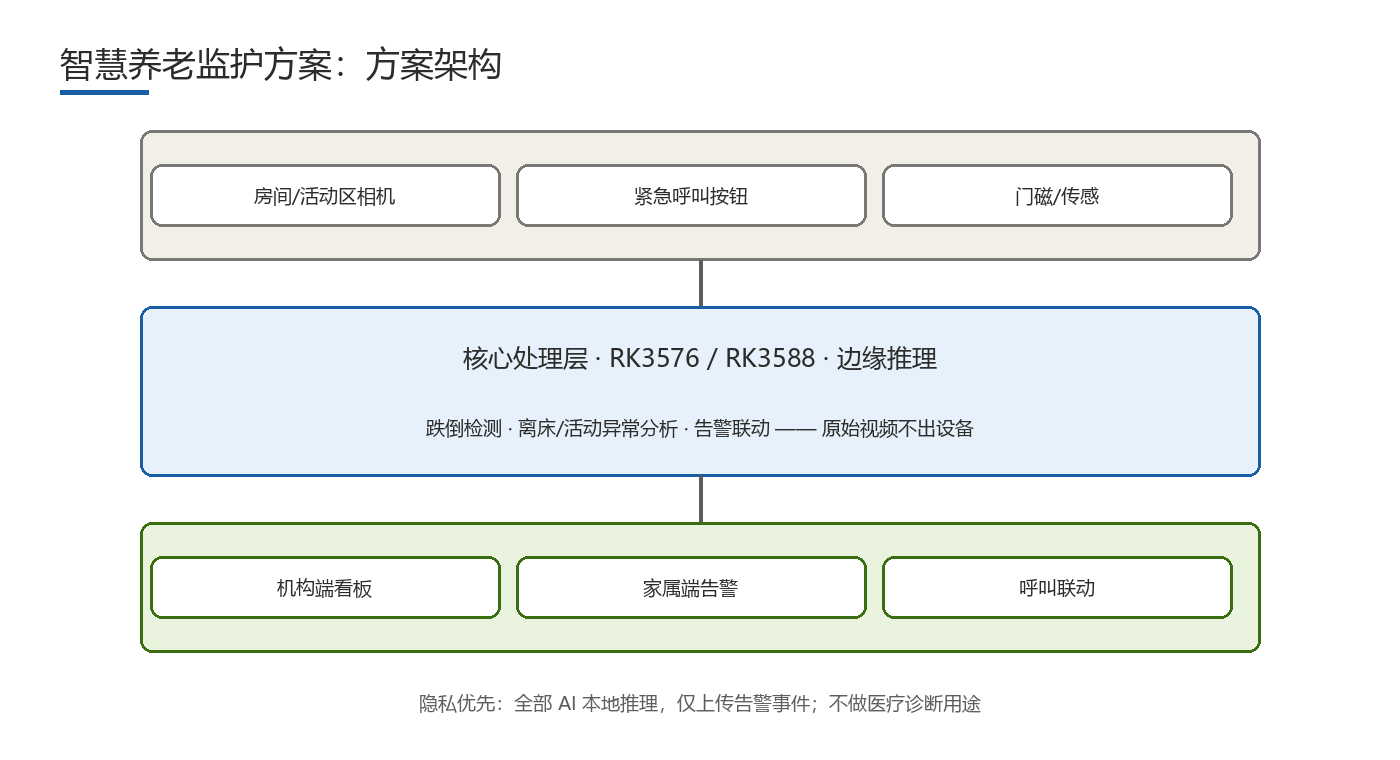
Care facilities and home care share one dilemma: detecting falls and emergencies promptly without making seniors feel watched or letting video leak out. Based on RK3576/RK3588 core boards, fall detection, bed-exit monitoring and activity anomaly analysis run entirely on the local NPU — raw video never leaves the device, only alert events are reported. The solution supports emergency call linkage and dual-channel alerts to family and facility staff. Free requirement review, with selection advice within 48 hours.
Pain Points
- Care facilities are short-staffed with long night-round intervals, so falls and accidents are found late
- Traditional CCTV only records without analysis, offering no prevention — only after-the-fact review
- Cloud video solutions raise serious privacy concerns and face resistance from seniors and families
- Emergencies rely on seniors calling for help themselves, leaving those immobilized undiscovered
- Families want visibility into seniors' status while facilities fear liability from video leaks
Recommended Hardware Configuration
| SoC platform | RK3576 (4×Cortex-A72 + 4×Cortex-A53) as the mainstay; RK3588 optional for facility-side nodes |
|---|---|
| AI computing power | 6TOPS NPU with fall detection and behavior analysis running fully on-device |
| Video input | MIPI CSI camera input for bedrooms, bathroom entrances, living rooms and other monitored spots |
| Emergency call | GPIO/serial access for emergency call buttons, linked with the alert system |
| Network | Wi-Fi/Ethernet for facility or home networks, with optional 4G backup |
| Structure & thermal | Fanless silent design in a compact enclosure suitable for wall mounting in living spaces |
Software Capabilities
- Fall detection: pose algorithms run on the local NPU, triggering instant alerts on suspected falls
- Bed-exit monitoring: tracks nighttime bed exits and prolonged absence per daily routines, alerting duty staff on anomalies
- Activity anomaly analysis: learns daily activity patterns and auto-alerts on anomalies such as prolonged inactivity
- Privacy protection: raw video is processed locally and never leaves the device — only alert events and optional anonymized snapshots go to the cloud
- Dual-channel alerts: notifications reach both facility duty staff and family members' app, with emergency call button linkage
Deliverables & Services
- Free requirement review: defining room layouts, monitoring points and alert workflow design
- Hardware design: monitoring terminal carrier board, emergency call integration and room-friendly enclosure design
- BSP/driver/algorithm: OS customization, camera drivers and fall/bed-exit model deployment
- Prototype integration: sample-room testing, false-alarm tuning and alert chain verification
- Pilot and mass production: phased deployment by room count with O&M and model iteration support
FAQ
Q:How does the solution protect privacy while still catching emergencies in time?
The key is on-device inference with event-only reporting: fall detection, bed-exit monitoring and other algorithms run entirely on the local NPU, raw video never leaves the device, and only structured alert events plus optional anonymized snapshots go to the cloud. Seniors are not continuously watched, yet facilities and families receive anomaly notifications immediately — balancing privacy with response speed.
Q:How is the false-alarm rate of fall detection controlled? What if a senior is falsely flagged?
False alarms mainly come from lighting changes, occlusion and similar postures. We tune algorithm parameters and camera angles through sample-room testing, and sensitivity can be configured per room. When an alert triggers, duty staff confirm it manually before escalation, so false alarms don't disturb families directly. We recommend piloting a few sample rooms and scaling up only after field results meet targets.
Q:Does the solution provide medical diagnosis capabilities?
No. This solution is a safety monitoring and daily-assistance tool that detects and alerts on events such as falls, bed exits and activity anomalies. It is not intended for diagnosing or treating any medical condition. Health assessments should be performed by professional medical institutions; the solution's event data can serve as reference information in care records.
Q:For multi-room deployment in a care facility, how are cost and management handled?
The facility side can deploy grouped multi-room access, with a unified duty console receiving alerts by priority to reduce manual screen-watching. Hardware is purchased and deployed in batches by room count, with low-volume orders supported for pilots. Configuration and budget can be planned per room count and monitoring points during the free requirement review — we reply with selection advice within 48 hours.
Related Technical Articles
Share your scenario and requirements — free requirement review, selection advice within 48 hours.
Get a Free Quote →