UAV Onboard Vision and Video Transmission Solution
Industrial UAVs on inspection, mapping and emergency missions must ingest several camera feeds, recognize targets on board and encode a low-bitrate transmission stream. Built on the RK3588 core board (4×A76 + 4×A55, 6TOPS NPU), this solution covers multi-camera input, NPU edge inference, H.265 real-time encoding and a lightweight low-power design, delivered in modules with the transmission link aligned to your existing link. Request a free requirement review and get selection advice within 48 hours.
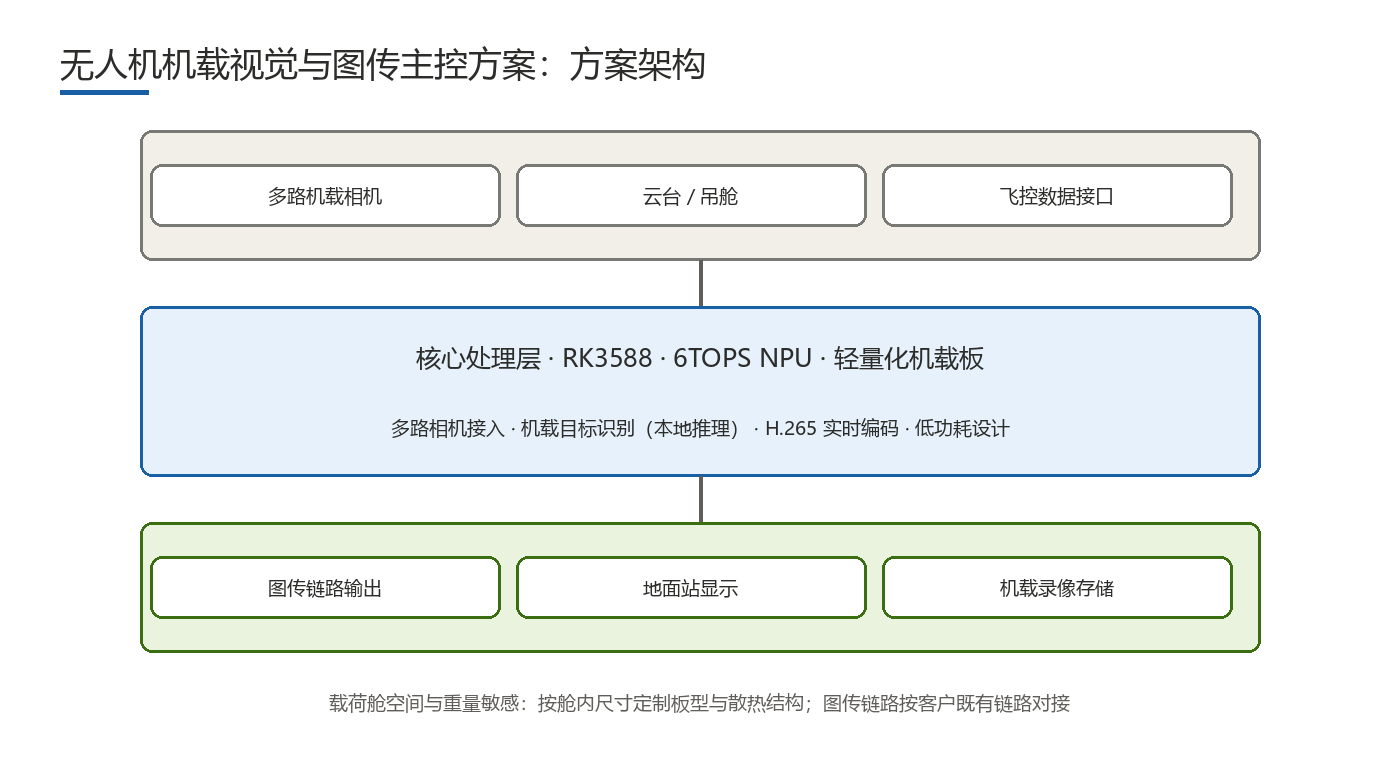
Pain Points
- Several cameras must ingest at once, and balancing frame rate against latency strains onboard compute
- Recognition can only happen after downlink, so bandwidth limits and results arrive too late
- Payload weight and power are tight; general-purpose industrial boards are heavy, run hot and drain endurance
- Camera interfaces and transmission links differ per vendor, causing repeated re-integration work
- Small-batch airframe iterations demand a reusable controller instead of new hardware per model
Recommended Hardware Configuration
| SoC platform | RK3588 core board (4×Cortex-A76 + 4×Cortex-A55) for parallel multi-stream video and inference |
|---|---|
| AI computing power | 6TOPS NPU running detection and recognition models on board to reduce reliance on the downlink |
| Memory & storage | LPDDR4/LPDDR5 and eMMC sized by camera channel count, with local event-clip buffering |
| Camera input | Multi-channel MIPI CSI cameras with custom cabling and connectors for the payload structure (refer to the chip datasheet) |
| Video encoding & transmission | Hardware H.265 encoding with standard stream output; the transmission link follows the customer's existing link |
| Structure & power | Core board plus custom carrier for weight reduction, wide-voltage input and optimized thermal paths for onboard space |
Software Capabilities
- Multi-camera capture: synchronized MIPI CSI multi-channel input with a unified time base to prevent frame drift
- NPU edge inference: model conversion and quantization, running detection and recognition on board with structured output
- Encoding and transmission: low-bitrate H.265 encoding, adaptive bitrate and standard stream protocols for your existing link
- Lightweight system trimming: pruning OS components and startup items to shorten power-on-to-stream time and cut power draw
- Event recording and upload: trigger-based buffering of key clips with automatic upload once the link recovers
Deliverables & Services
- Free requirement review: clarifying payload form factor, camera channels, recognition targets and transmission protocol
- Hardware design: core board selection, carrier board with camera and transmission interfaces, weight and thermal budgeting
- BSP/driver/algorithm: OS trimming, multi-camera drivers, model conversion and NPU deployment
- Prototype integration: ground-link and flight testing to verify frame rate, latency, bitrate and temperature rise
- Pilot and mass production: low-volume orders, production test plans and long-term supply support
FAQ
Q:Should I choose RK3588 or RK3576 for a UAV onboard controller?
It depends mainly on compute and camera channels. For multiple cameras with real-time recognition and higher encoding bitrate, we recommend RK3588 (4×A76 + 4×A55, 6TOPS NPU). For lighter models, fewer channels and tighter power and weight budgets, RK3576 (4×A72 + 4×A53, 6TOPS NPU) can be evaluated. Share your channel count, resolution, frame rate and model type, and we reply with selection advice within 48 hours after a free requirement review.
Q:How is the cost of a custom onboard controller module estimated?
Cost is driven by core board configuration (memory and storage), carrier board and interface complexity, structural and thermal parts, cabling customization, and system plus algorithm effort. Pricing follows your requirement list. We suggest a low-volume order for a verification board first, then mass production once frame rate, latency and temperature rise pass field tests, avoiding a large one-off investment.
Q:Can we keep our existing video transmission link?
Yes. The solution outputs standard video streams and the transmission link follows your existing one; we handle encoding parameters, bitrate control and link handshake integration. If your link uses a proprietary protocol, sharing the protocol document is enough for us to assess the adaptation approach and effort.
Q:How is stability ensured under onboard vibration and temperature swings?
Structurally we use locking connectors, reinforced critical components and optimized thermal paths; on the software side we configure watchdogs, automatic recovery and degradation strategies such as lowering bitrate or reducing channels to keep the video link alive. Reliability is verified under real operating conditions, and vibration plus temperature-rise validation can be arranged during the prototype stage per project requirements.
Related Technical Articles
Share your scenario and requirements — free requirement review, selection advice within 48 hours.
Get a Free Quote →