Paperless Conference & Electronic Nameplate Solution
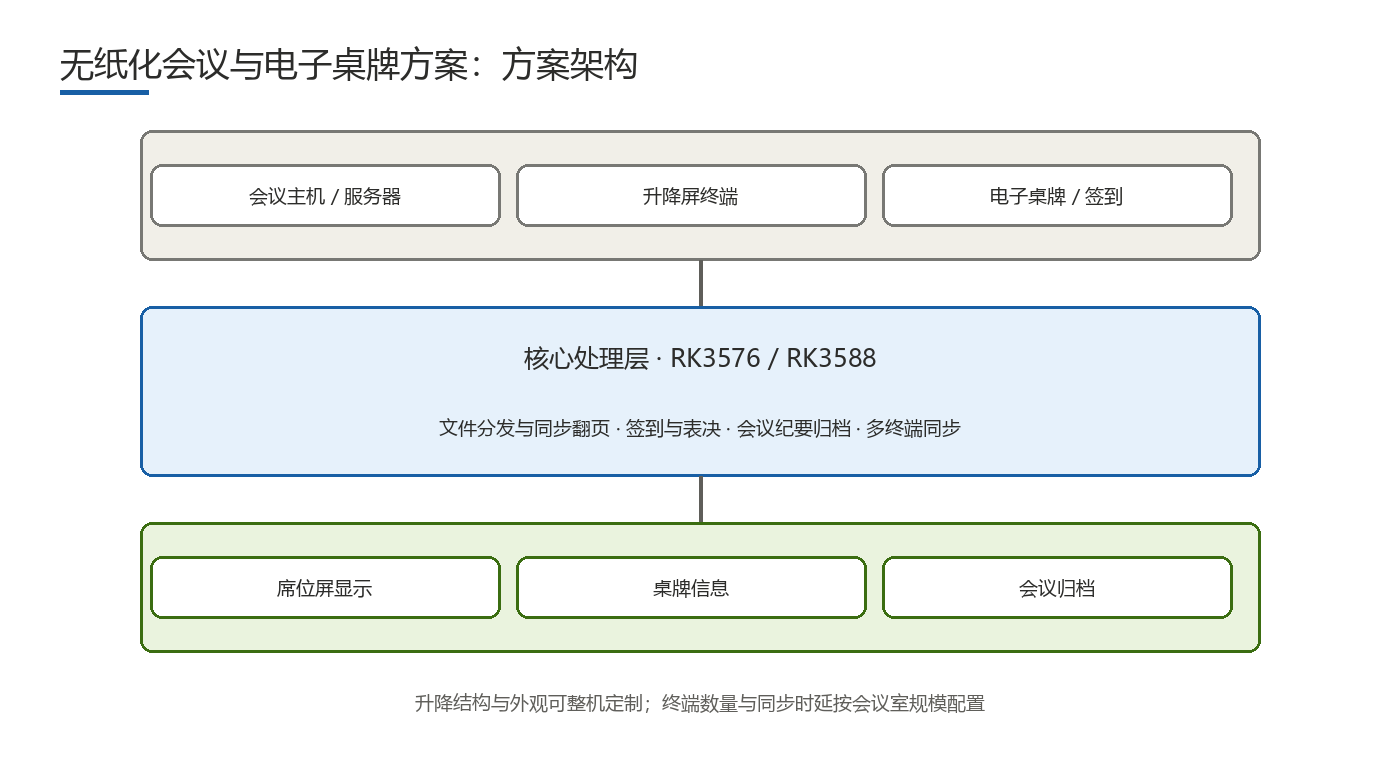
Printing, distributing and collecting paper materials is costly, updating nameplates and documents is inconvenient, and the meeting itself is hard to archive. Built on RK3576 and RK3588 core boards, this solution drives lift-screen and electronic nameplate terminals for document distribution, synchronized page turning, check-in and voting, and minute archiving, with full device and enclosure customization. Hongyin Tech offers a free requirement review and prototype integration — send us your scenario and receive selection advice within 48 hours.
Pain Points
- Paper materials are expensive to print and distribute, and last-minute edits require reprinting
- Electronic nameplate content is hard to update, making attendee and seat changes inefficient
- Documents and page turns across terminals fall out of sync, making meeting pacing hard to control
- Check-in and voting still rely on manual counting, which is slow and error-prone
- Meeting materials and minutes are archived in scattered places, making later search and traceability difficult
Recommended Hardware Configuration
| SoC platform | RK3576 (4×A72 + 4×A53) or RK3588 (4×A76 + 4×A55), chosen by display requirements; refer to the datasheet |
|---|---|
| AI computing power | 6TOPS NPU for conference aids such as speech transcription and image processing |
| Memory & storage | Optional LPDDR4/LPDDR5 with eMMC, enabling local caching of meeting files |
| Display & touch | MIPI/eDP driving lift screens and nameplate panels with capacitive touch |
| Network & interfaces | Gigabit Ethernet with optional Wi-Fi; USB and RS485 for peripherals and central control |
| Structure & power | Custom structure for lift mechanisms, nameplate enclosures and cable routing; wide-voltage power |
Software Capabilities
- Document distribution: one-click push of meeting materials to all terminals with permission and visibility control
- Synchronized page turning: the presenter's actions sync across all terminals, with annotation and follow modes
- Check-in and voting: electronic check-in, agenda voting and real-time tallying with instant result summaries
- Minute archiving: unified archiving of recordings, video and minutes with search and export
- Terminal management: OTA updates, status monitoring and bulk configuration for centralized O&M
Deliverables & Services
- Requirement review (free): clarify seat count, screen specs, functions and structure needs, and deliver selection advice
- Hardware design: core board selection, carrier board customization, screen driving and lift-structure design
- BSP/drivers/algorithms: system trimming, touch and panel driver adaptation, and conference app development
- Prototype integration: assemble the prototype, test synchronized paging and voting, and validate the structure
- Low-volume and mass-production support: low-volume MOQ, continuous supply and firmware upgrade maintenance
FAQ
Q:Should a paperless conference terminal use RK3576 or RK3588?
If the terminal mainly handles document display, synchronized page turning, check-in and voting, RK3576 (4×A72 + 4×A53, 6TOPS NPU) is sufficient with better cost and power efficiency. For higher-resolution multi-screen output, video conferencing or heavier image processing, choose RK3588 (4×A76 + 4×A55). Refer to the datasheet for details. Submit your requirements for free selection advice within 48 hours.
Q:What makes up the cost of a paperless conference solution?
Cost comes mainly from the number of terminals, screen specs and sizes, structural parts such as lift mechanisms, software functions like synchronized paging, voting and minute archiving, and whether integration with an existing conference system is needed. A standard core board approach changes little and shortens lead time, while structure complexity strongly affects device cost. Start with a free requirement review to define the feature list; we provide an effort estimate within 48 hours.
Q:Can the solution integrate with an existing room control or conference management system?
Yes. Terminals provide an SDK and protocol documentation, communicating over Ethernet or serial with room controllers and conference management systems for centralized power, document push and status collection. Since control protocols vary by vendor, the exact scope depends on their interface documents. Share them during the requirement review and we will reply on feasibility within 48 hours.
Q:Conference sites demand high stability — how does the terminal stay reliable over long sessions?
Three ways: industrial-grade storage and wide-voltage power with a watchdog to prevent hangs; local display and recording continue during network outages and sync once reconnected; and bulk configuration plus OTA updates for centralized maintenance. Actual temperature and aging figures depend on the final build — validate with extended prototype testing.
Related Technical Articles
Share your scenario and requirements — free requirement review, selection advice within 48 hours.
Get a Free Quote →