Industrial HMI & Host Computer Solution
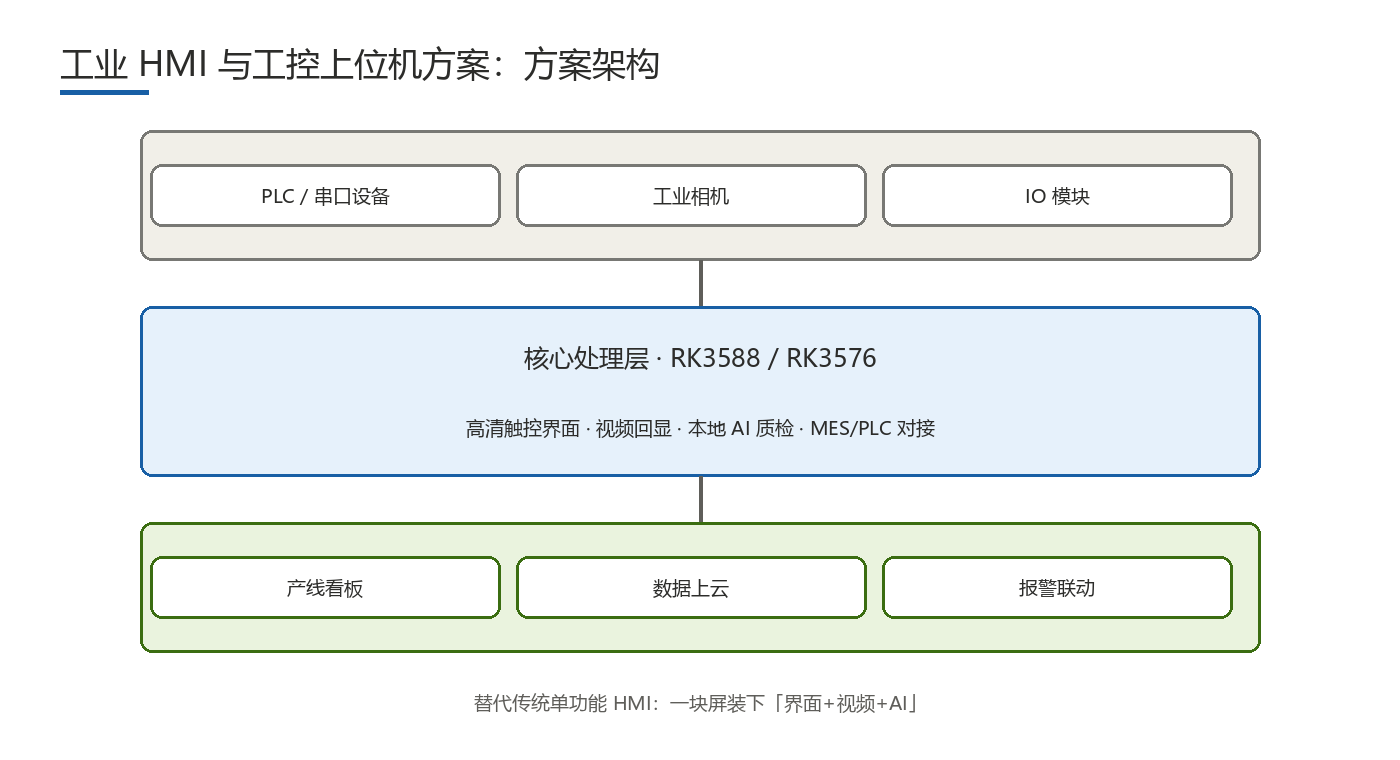
For production-line HMI upgrades, HONGYIN TECH delivers an integrated industrial HMI and host computer solution on RK3588/RK3576: HD touch UI, multi-channel video feedback, local AI inspection and PLC/MES data integration on a single device, replacing single-function HMIs. The unit is engineered for industrial environments with wide-temperature, EMI-resilient and mounting-ready designs. Full support from requirement review to small-batch delivery, with platform recommendations within 48 hours.
Pain Points
- Legacy HMIs only render UIs, forcing separate devices for video feedback, data acquisition and AI inspection
- Tight floor space means stacked devices, messy cabling and more failure points
- Equipment data never reaches MES, stalling digital transformation at the integration stage
- Dust and heat on the shop floor shorten the life of consumer-grade hardware
- Upgrade budgets for aging lines are limited, requiring cost-controlled platform tiers
Recommended Hardware Configuration
| SoC platform | RK3588 (4x A76 + 4x A55, 6TOPS NPU) for heavy workloads and dense video feedback, or RK3576 (4x A72 + 4x A53, 6TOPS NPU) as the cost tier; see chipset datasheet for details |
|---|---|
| Display output | MIPI-DSI/LVDS/eDP panel interfaces with custom 7-15.6-inch industrial touchscreens, optional HDMI for external expansion |
| Video input | MIPI-CSI cameras or USB/network video input for station video feedback and visual assistance |
| AI compute | Built-in 6TOPS NPU running local AI tasks such as station defect detection and safety behavior recognition |
| Networking & I/O | Dual GbE, RS485/RS232, optional CAN, DI/DO and USB for PLC, instrumentation and line peripheral integration |
| Enclosure & thermal | Wide-temperature components with fanless cooling; embedded/arm/panel-mount structures customized per line requirements |
Software Capabilities
- OS: Android / Debian / Ubuntu chosen to match the host software ecosystem, with system trimming
- HMI: HD touch UI supporting customer SCADA/HMI software or custom interface deployment
- Video feedback: multi-channel video input, decoding and display with station views and operation UI on the same screen
- Local AI: RKNN model deployment for edge AI such as station defect pre-screening and personnel safety recognition
- Data integration: PLC data collection via Modbus/OPC UA-class industrial protocols, reported to MES/cloud over MQTT/HTTP
Deliverables & Services
- Free requirement review: capture display specs, video channels, AI needs and integration protocols, then deliver platform-tier and solution proposals
- Hardware design: turnkey hardware, panel selection, industrial I/O and mounting structure design
- BSP/driver/algorithm adaptation: OS customization, touch and peripheral drivers, industrial protocol stacks and AI model deployment
- Prototype integration: joint debugging with customer host software and line equipment, field validation and test reports
- Small-batch and volume support: low MOQ, batch consistency control and long-term supply commitment
FAQ
Q:Can one device really replace the existing HMI plus industrial PC?
RK3588/RK3576 platforms integrate touch display, video decode, industrial I/O and NPU inference on one board, so most scenarios can consolidate devices and simplify cabling. Full replacement depends on your existing software architecture. Share your current setup for a free requirement review and consolidation proposal.
Q:Do you handle PLC and MES integration?
Yes. Hardware provides industrial interfaces such as RS485 and Ethernet; software adapts common protocols like Modbus for PLC data collection and reports to MES per your interface specification. Integration needs are confirmed during the free requirement review and folded into the delivery plan after effort assessment.
Q:How do RK3588 and RK3576 tier within this solution?
For scenarios centered on UI, data acquisition and light video feedback, RK3576 is more cost-effective; for multi-channel video feedback, local AI inspection or heavier inference, RK3588 is recommended. Both platforms offer 6TOPS NPU; the difference lies mainly in CPU and decode capability. Selection advice is available within 48 hours.
Q:How is stability ensured in hot, dusty shop floors?
The unit uses wide-temperature components and a fanless sealed thermal design to reduce dust ingress and fan failure points. System-level high/low-temperature testing is performed at prototype stage with results verified by real measurements, and key models can reference our validated track record for industrial wide-temperature core boards.
Related Technical Articles
Share your scenario and requirements — free requirement review, selection advice within 48 hours.
Get a Free Quote →