Elevator IoT Monitoring Terminal Solution
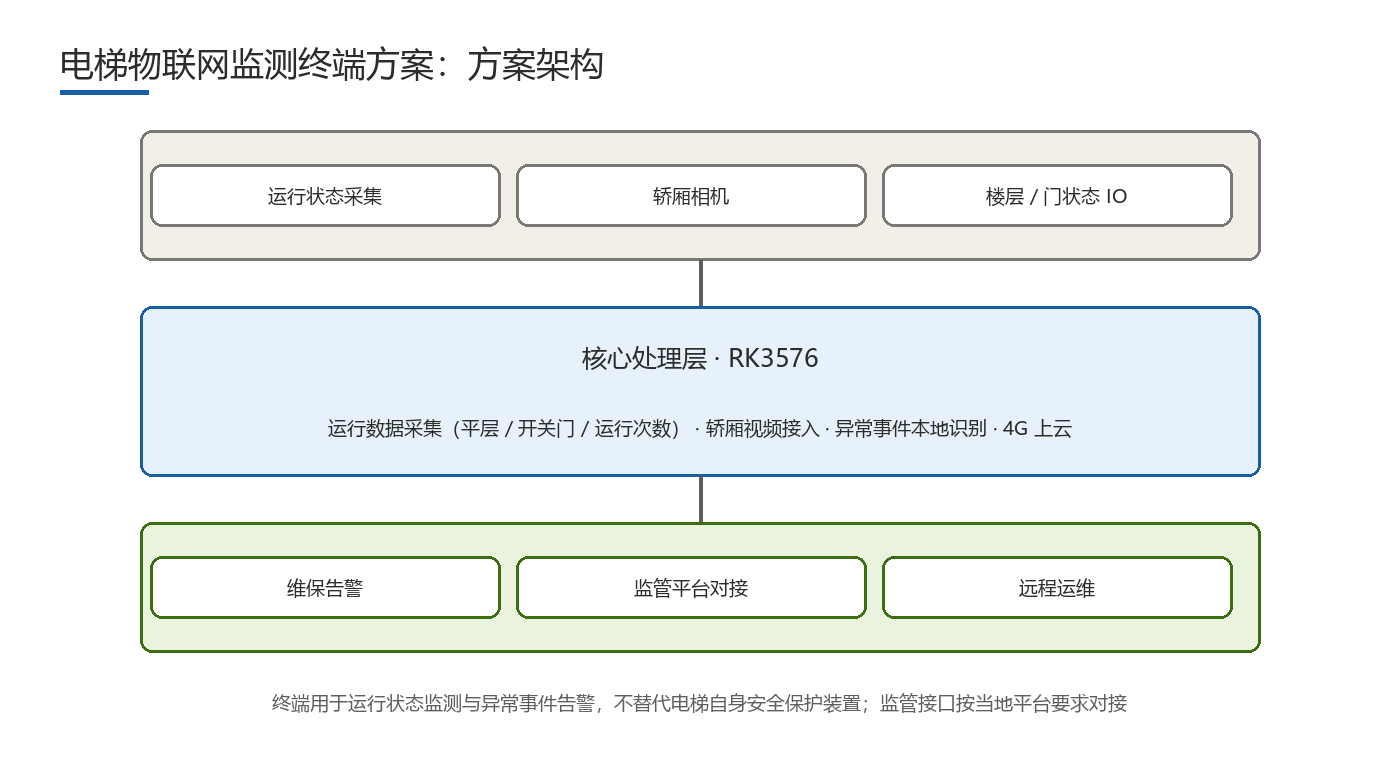
Elevators are widely distributed and serviced by many parties, yet operating and fault information is still largely gathered through manual inspection. Built on the RK3576 core board (4×A72 + 4×A53, 6TOPS NPU), this solution captures leveling, door open/close and trip-count data, integrates in-car video with on-device abnormal-event detection and alarm linkage, and reports over 4G for remote O&M, with data interfaces integrated according to local regulatory platform requirements. Hongyin Tech offers a free requirement review and core board or complete-device customization — reach out and get selection advice within 48 hours.
Pain Points
- Operating data is collected by manual inspection; leveling and door status are not continuously recorded
- In-car video and operating data live in separate systems, making post-event correlation difficult
- Abnormal events cannot be identified locally, so response waits for passenger reports and lags behind
- With many distributed elevators, 4G cloud connectivity and remote O&M upgrades involve heavy integration work
- Local regulatory platforms use different interface specs, raising data integration and compliance efforts
Recommended Hardware Configuration
| SoC platform | RK3576 (4×Cortex-A72 + 4×Cortex-A53); refer to the datasheet for details |
|---|---|
| AI computing power | 6TOPS NPU for on-device abnormal-event recognition |
| Memory & storage | Optional LPDDR4/LPDDR5 with eMMC, buffering locally during network outages |
| Video input | MIPI CSI / USB camera input for in-car video capture and local recording |
| Data acquisition | RS485/RS232 ports with digital and analog inputs for leveling, door and trip-count signals |
| Network & power | 4G cellular with optional Ethernet; wide-voltage power input and watchdog |
Software Capabilities
- Operating data acquisition: parses leveling, door and trip-count signals and reports structured status periodically
- Abnormal-event detection: NPU runs recognition models locally for on-site judgment and snapshot capture
- Alarm linkage: supports local sound-light and relay output plus cloud alert push, triggered by configurable rules
- Store-and-forward: buffers data and video clips during 4G outages and auto-uploads once the network recovers
- Platform integration: MQTT/HTTP reporting with data interfaces aligned to local regulatory platform requirements, plus protocol documentation
Deliverables & Services
- Requirement review (free): clarify monitoring items, sensor and video input lists, and deliver selection and regulatory integration advice
- Hardware design: core board selection, carrier board customization, interface and protective enclosure design
- BSP/drivers/algorithms: system trimming, acquisition driver adaptation and abnormal-event model deployment
- Prototype integration: build the prototype, run on-site elevator tests, and integrate with cloud and regulatory platforms
- Low-volume and mass-production support: low-volume MOQ, continuous supply and firmware upgrade maintenance
FAQ
Q:Why choose RK3576 for an elevator IoT monitoring terminal?
RK3576 pairs a 4×A72 + 4×A53 architecture with a 6TOPS NPU, handling multi-channel data acquisition, in-car video input and on-device abnormal-event detection at once, with a balanced power and cost profile suited to distributed elevator terminals. For higher video specs or multi-screen output, RK3588 can be evaluated; refer to the datasheet for details. Submit your requirements for free selection advice within 48 hours.
Q:How are the customization cost and timeline for an elevator monitoring terminal estimated?
Cost depends mainly on the number of acquisition signals, video channels, enclosure protection level and how many platforms must be integrated. A standard core board plus carrier board approach changes little and shortens lead time, while full-enclosure and multi-platform integration add work. Start with a free requirement review to define the scope; we provide a selection and effort estimate within 48 hours, without inflated pricing.
Q:How does the monitoring terminal connect to a local special-equipment regulatory platform?
The device supports common reporting protocols such as MQTT and HTTP and reserves structured data fields. Because local regulatory platforms use different interface specs, data interfaces are integrated according to local regulatory platform requirements, subject to the platform's technical documents. Share the platform interface documents during the requirement review and we will arrange engineer-assisted integration, replying on feasibility within 48 hours.
Q:Elevator machine rooms and shafts are harsh environments — how does the terminal stay reliable?
The design addresses power, storage and network: wide-voltage input with a watchdog prevents hangs; eMMC buffering keeps data safe during outages; and 4G reconnects automatically with resumable upload. The enclosure can be customized for machine-room or car installation, and specific temperature and protection ratings depend on the final build — validate with prototype testing.
Related Technical Articles
Share your scenario and requirements — free requirement review, selection advice within 48 hours.
Get a Free Quote →